ARTIFICIAL INTELLIGENCE [AI] IS NOT USED IN COMPOSING NYPPL SUMMARIES OF JUDICIAL AND QUASI-JUDICIAL DECISIONS.

Jan 16, 2026

New York State Department of Education's denial of petitioner's request for approval of petitioner's employment as a teacher challenged

In this action the petitioner [Plaintiff] contended that the New York State Department of Education's [SED] denial of his application for clearance for employment as a teacher was arbitrary and capricious. 

The Appellate Division, noting that "In a CPLR article 78 proceeding to review a determination of an administrative agency, the standard of judicial review is whether the determination was made in violation of lawful procedure, was affected by an error of law, or was arbitrary and capricious or an abuse of discretion", agreed with the Supreme Court's holding that SED's determination was not arbitrary and capricious, and affirmed the Supreme Court's dismissal of Plaintiff's petition challenging the SED's determination.

In the words of the Appellate Division, "An action is arbitrary and capricious when it is taken without sound basis in reason or regard to the facts. When a determination is supported by a rational basis, it must be sustained even if the reviewing court would have reached a different result".

Click HERE to access the Appellate Division's decision posted on the Internet.


Selected links to articles posted on the Internet that may be of interest:

New York lawmakers plot more AI regulations after RAISE Act Capitol Confidential with Dan Clark

Jan 15, 2026

The Doctrine of Res Judicata held to bar litigating petitioner's instant complaint

In this action the Appellate Division affirmed a Supreme Court's ruling that a prior decision denying CPLR Article 78 relief bars a subsequent plenary action where, as here, the same issues were raised, fully litigated, and necessarily decided.

Further, the Appellate Division opined that even if the above claims were not barred, the complaint fails to state a cause of action as his religious discrimination claims fail to connect Plaintiff's alleged religious beliefs to the requirement for vaccination as Plaintiff's "conclusory assertions" of discrimination are "unsupported by sufficient factual allegations".

As to Plaintiff's remaining claims, the Appellate Division concluded that these were also properly dismissed for failure to state a cause of action as:

1. Plaintiff's claim for declaratory relief is moot, since the City rescinded the vaccine mandate in February 2023;

2. Plaintiff's claim for intentional infliction of emotional distress is barred as against defendant City on public policy grounds; and

3. Plaintiff's claims otherwise fails to allege extreme and outrageous conduct by the individually named defendant.

4. Plaintiff's Free Exercise claim, "[Plaintiff] has no private right of action to recover damages for violations of the New York State Constitution, since the alleged wrongs could be addressed by alternative remedies, including those pursued" here under the City HRL and State HRL"

5. Plaintiff's breach of contract claim fails for lack of standing as Plaintiff "has no individual right to enforce the collective bargaining agreement".

Click HERE to access the Appellate Division's decision posted on the Internet.


Jan 14, 2026

New York State Comptroller announces school district tax cap levy to remain at 2%

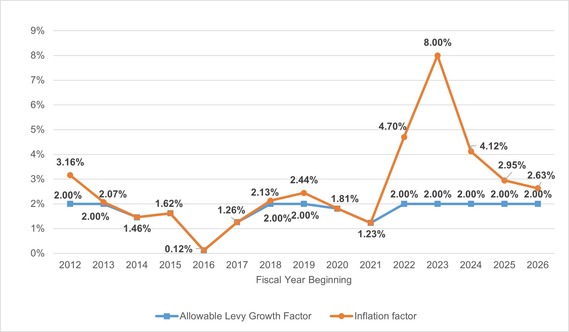
On January 14, 2026, New York State Comptroller Thomas Peter DiNapoli announced school district tax cap levy will remain at 2%.

Property tax levy growth for New York’s school districts and 10 cities will remain capped at 2% for the fifth year in a row, according to data released on January 14, 2026,  by State Comptroller DiNapoli.

The tax cap, which first applied to local governments (excluding New York City) and school districts in 2012, limits annual tax levy increases to the lesser of the rate of inflation or 2% with certain exceptions. The law includes provisions that allow school districts and municipalities to override the cap. DiNapoli’s office calculated the inflation factor at 2.63% for those with a June 30, 2027, fiscal year end.

“For the fifth consecutive year, the property tax levy for school districts and 10 cities will be capped at 2%,” DiNapoli said. “School district and municipal officials must continue to find ways to deliver services efficiently as they deal with higher costs and the potential impact of federal actions.”

The 2% allowable levy growth affects the tax cap calculations for 675 school districts and 10 cities with fiscal years starting July 1, 2026, including the “Big Four” cities of Buffalo, Rochester, Syracuse and Yonkers, as well as Amsterdam, Auburn, Corning, Long Beach, Watertown, and White Plains.

ALGF Chart

Note: Allowable levy growth is expressed as a percentage. 

List of allowable tax levy growth factors for all local governments
Real Property Tax Cap and Tax Cap Compliance web page


Crediting a public employee's service for retirement purposes when the individual does not participate in the employer's time keeping system

New York State elected or appointed officials not participating in the employer's time keeping system are required to prepare a "Record of Work Activities" [ROA] recording the individual's work activities for a period of three consecutive months in order to receive service credit in the retirement system. Should the official fail to record, sign and submit an ROA "within the required time frame," crediting service for retirement purposes is suspended until such time as an ROA that complies with regulatory requirements is properly submitted.

In the instant situation the official [Petitioner] served as an elected City Council member and did not participate in the City's time keeping system. Petitioner, however, prepared and submitted a ROA reporting 60 hours of work over the first three months of 2012, or an average of 3.33 six-hour workdays per month. 

In July 2012, the City Council, including Petitioner, issued a resolution establishing Petitioner's days per month based on her ROA, and that figure was reported to, and ultimately certified by, the New York State and Local Retirement System [Retirement System] in August 2012. 

Petitioner's term as a City Council member ended in December 2015.

Subsequently Petitioner, then serving as the City's Comptroller, submitted a revised ROA to the Retirement System, increasing her reported hours for the same three-month period of service as an elected member of the City Council and requested that her retirement service credit be recalculated. Ultimately the Pension Integrity Bureau of the Retirement System [Bureau] advised Petitioner that her revised ROA for her service as a City Council member had been submitted "well outside of the windows to submit or amend an ROA, must be rejected". Petitioner appealed the Bureau's determination.

Following an evidentiary hearing, a Hearing Officer found that Petitioner was not entitled to a recalculation of her service credit as her revised ROA was both untimely and failed to encompass an alternative period of three consecutive months within the same calendar year as her initial ROA.

The Retirement System adopted the Hearing Officer's findings of fact and conclusions of law and denied Petitioner's application. Petitioner appealed the Retirement System's determination but the Appellate Division sustained the Retirement System's decision.

Click HERE to access the Appellate Division's decision posted on the Internet.

Editor in Chief Harvey Randall served as Director of Personnel, SUNY Central Administration, Director of Research , Governor's Office of Employee Relations; Principal Attorney, Counsel's Office, New York State Department of Civil Service, and Colonel, New York Guard. Consistent with the Declaration of Principles jointly adopted by a Committee of the American Bar Association and a Committee of Publishers and Associations, the material posted to this blog is presented with the understanding that neither the publisher nor NYPPL and, or, its staff and contributors are providing legal advice to the reader and in the event legal or other expert assistance is needed, the reader is urged to seek such advice from a knowledgeable professional.

CAUTION

Subsequent court and administrative rulings, or changes to laws, rules and regulations may have modified or clarified or vacated or reversed the information and, or, decisions summarized in NYPPL. For example, New York State Department of Civil Service's Advisory Memorandum 24-08 reflects changes required as the result of certain amendments to §72 of the New York State Civil Service Law to take effect January 1, 2025 [See Chapter 306 of the Laws of 2024]. Advisory Memorandum 24-08 in PDF format is posted on the Internet at https://www.cs.ny.gov/ssd/pdf/AM24-08Combined.pdf. Accordingly, the information and case summaries should be Shepardized® or otherwise checked to make certain that the most recent information is being considered by the reader.
THE MATERIAL ON THIS WEBSITE IS FOR INFORMATION ONLY. AGAIN, CHANGES IN LAWS, RULES, REGULATIONS AND NEW COURT AND ADMINISTRATIVE DECISIONS MAY AFFECT THE ACCURACY OF THE INFORMATION PROVIDED IN THIS LAWBLOG. THE MATERIAL PRESENTED IS NOT LEGAL ADVICE AND THE USE OF ANY MATERIAL POSTED ON THIS WEBSITE, OR CORRESPONDENCE CONCERNING SUCH MATERIAL, DOES NOT CREATE AN ATTORNEY-CLIENT RELATIONSHIP.
New York Public Personnel Law. Email: publications@nycap.rr.com