New York lawmakers plot more AI regulations after RAISE Act Capitol Confidential with Dan Clark
Jan 15, 2026
The Doctrine of Res Judicata held to bar litigating petitioner's instant complaint
In this action the Appellate Division affirmed a Supreme Court's ruling that a prior decision denying CPLR Article 78 relief bars a subsequent plenary action where, as here, the same issues were raised, fully litigated, and necessarily decided.
Further, the Appellate Division opined that even if the above claims were not barred, the complaint fails to state a cause of action as his religious discrimination claims fail to connect Plaintiff's alleged religious beliefs to the requirement for vaccination as Plaintiff's "conclusory assertions" of discrimination are "unsupported by sufficient factual allegations".
As to Plaintiff's remaining claims, the Appellate Division concluded that these were also properly dismissed for failure to state a cause of action as:
1. Plaintiff's claim for declaratory relief is moot, since the City rescinded the vaccine mandate in February 2023;
2. Plaintiff's claim for intentional infliction of emotional distress is barred as against defendant City on public policy grounds; and
3. Plaintiff's claims otherwise fails to allege extreme and outrageous conduct by the individually named defendant.
4. Plaintiff's Free Exercise claim, "[Plaintiff] has no private right of action to recover damages for violations of the New York State Constitution, since the alleged wrongs could be addressed by alternative remedies, including those pursued" here under the City HRL and State HRL"
5. Plaintiff's breach of contract claim fails for lack of standing as Plaintiff "has no individual right to enforce the collective bargaining agreement".
Click HERE to access the Appellate Division's decision posted on the Internet.
Jan 14, 2026
New York State Comptroller announces school district tax cap levy to remain at 2%
On January 14, 2026, New York State Comptroller Thomas Peter DiNapoli announced school district tax cap levy will remain at 2%.
Property tax levy growth for New York’s school districts and 10 cities will remain capped at 2% for the fifth year in a row, according to data released on January 14, 2026, by State Comptroller DiNapoli.
The tax cap, which first applied to local governments (excluding New York City) and school districts in 2012, limits annual tax levy increases to the lesser of the rate of inflation or 2% with certain exceptions. The law includes provisions that allow school districts and municipalities to override the cap. DiNapoli’s office calculated the inflation factor at 2.63% for those with a June 30, 2027, fiscal year end.
“For the fifth consecutive year, the property tax levy for school districts and 10 cities will be capped at 2%,” DiNapoli said. “School district and municipal officials must continue to find ways to deliver services efficiently as they deal with higher costs and the potential impact of federal actions.”
The 2% allowable levy growth affects the tax cap calculations for 675 school districts and 10 cities with fiscal years starting July 1, 2026, including the “Big Four” cities of Buffalo, Rochester, Syracuse and Yonkers, as well as Amsterdam, Auburn, Corning, Long Beach, Watertown, and White Plains.
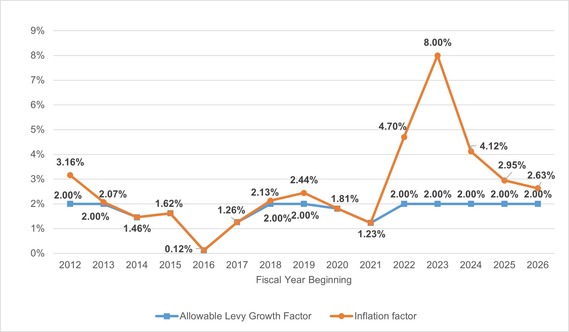
Note: Allowable levy growth is expressed as a percentage.
List of allowable tax levy growth factors for all local governments
Real Property Tax Cap and Tax Cap Compliance web page
Crediting a public employee's service for retirement purposes when the individual does not participate in the employer's time keeping system
New York State elected or appointed officials not participating in the employer's time keeping system are required to prepare a "Record of Work Activities" [ROA] recording the individual's work activities for a period of three consecutive months in order to receive service credit in the retirement system. Should the official fail to record, sign and submit an ROA "within the required time frame," crediting service for retirement purposes is suspended until such time as an ROA that complies with regulatory requirements is properly submitted.
In the instant situation the official [Petitioner] served as an elected City Council member and did not participate in the City's time keeping system. Petitioner, however, prepared and submitted a ROA reporting 60 hours of work over the first three months of 2012, or an average of 3.33 six-hour workdays per month.
In July 2012, the City Council, including Petitioner, issued a resolution establishing Petitioner's days per month based on her ROA, and that figure was reported to, and ultimately certified by, the New York State and Local Retirement System [Retirement System] in August 2012.
Petitioner's term as a City Council member ended in December 2015.
Subsequently Petitioner, then serving as the City's Comptroller, submitted a revised ROA to the Retirement System, increasing her reported hours for the same three-month period of service as an elected member of the City Council and requested that her retirement service credit be recalculated. Ultimately the Pension Integrity Bureau of the Retirement System [Bureau] advised Petitioner that her revised ROA for her service as a City Council member had been submitted "well outside of the windows to submit or amend an ROA, must be rejected". Petitioner appealed the Bureau's determination.
Following an evidentiary hearing, a Hearing Officer found that Petitioner was not entitled to a recalculation of her service credit as her revised ROA was both untimely and failed to encompass an alternative period of three consecutive months within the same calendar year as her initial ROA.
The Retirement System adopted the Hearing Officer's findings of fact and conclusions of law and denied Petitioner's application. Petitioner appealed the Retirement System's determination but the Appellate Division sustained the Retirement System's decision.
Click HERE to access the Appellate Division's decision posted on the Internet.
Jan 13, 2026
Failure to abide by a known policy of the employer can constitute disqualifying misconduct in determining an employee's eligibility for unemployment insurance benefits
An employee [Claimant] failed to provide negative COVID-19 test results at the beginning of her work week as required and was advised that her failure to do so in the future could result in her termination. Claimant was subsequently terminated after she failed to provide a negative COVID test result when she returned to work after a brief absence.
Claimant applied for but was subsequently administratively disqualified from receiving unemployment insurance benefits because she lost her employment due to misconduct. An Administrative Law Judge sustained that administrative determination, which decision was affirmed by the Unemployment Insurance Appeal Board. This decision by the Board affirmed a second time after Claimant asked the Board reconsidered its earlier decision.
Claimant appealed but the Appellate Division affirmed the Board's determination noting that "It is well settled that failure to abide by a known policy of the employer can constitute disqualifying misconduct" for the purpose of determining eligibility for unemployment insurance benefits".
Noting that Claimant was aware that she had to provide proof of a negative COVID-19 test result at the beginning of her work week, and that Claimant had testified that she had been tested for COVID-19 and had submitted the results to the employer via email or text message.
Claimant's program director testified and agreed that:
1. Claimant always maintained that she had submitted the required test results;
2. Claimant's program director testified that most of those results were never received; and
3. It had been made clear to Claimant, first orally and eventually in a written warning, that she must provide the results upon the start of her work week or face discipline.
Ultimately Claimant admitted that she had "failed to get tested and provide the results" on the day she returned to work in October 2021.
The Appellate Division held that Claimant's admitted violation of the [employer's] policy in October 2021, and, when coupled with Claimant's history of prior warnings, constituted substantial evidence supporting the Board's determination that "[Claimant] wase was terminated for disqualifying misconduct" and thus was ineligible for unemployment insurance benefits.
Click HERE to access the Appellate Division decision posted on the Internet.
Subscribe to:
Comments (Atom)