Summaries of, and commentaries on, selected court and administrative decisions and related matters affecting public employers and employees in New York State in particular and possibly in other jurisdictions in general.
Mar 26, 2026
Failing to name all necessary parties to the litigation is fatal to petitioner's cause of action
Mar 25, 2026
Termination of a probationary employee during the individual's probationary period
The New York City Department of Correction (DOC) terminated an employee from her non-competitive class position without notice and hearing. DOC subsequently reinstated the employee but rejected her request for backpay, whereupon the employee sued DOC for the back pay she claimed was due her.
Although the parties disputed whether Petitioner had completed her probationary period by the date of her discharge, the Appellate Division said it need not resolve that dispute because, even if Petitioner had completed her probationary period, she would not have been entitled to a pretermination hearing under the Civil Service Law, which affords tenure protections to employees serving in non-competitive class titles only once they have completed at least five years of continuous service.
Citing Civil Service Law §77, the Appellate Division held that "Because petitioner was not discharged in violation of the Civil Service Law, there is no basis to order her reinstated with backpay."
With respect to termination of a probationary employee prior end of his or her maximum period of probation in York v McGuire, 63 NY2d 760, the Court of Appeals set out the basic rules concerning the dismissal of probationary employees as follows:
“After completing his or her minimum period of probation and prior to completing his or her maximum period of probation, a probationary employee can be dismissed without a hearing and without a statement of reasons, as long as there is no proof that the dismissal was done for a constitutionally impermissible purpose, or in violation of statutory or decisional law, or the decision was made in bad faith”.
Mar 24, 2026
Mission Accomplished Transition Services to present The Power of Mentorship featuring Coach Carmen and others.
Special Assistant for Intergovernmental & Community Affairs at the NYS Department of Public Service, Ezra P. Scott Jr, is hosting the next Albany Professionals Under 40 and Friends' [APF 40] networking event which will focus on the importance of mentorship. The meeting will be held on:
Friday, March 27, 2026, 6:00 PM – 9:00 PM
at a new location
The Country Inn & Suites by Radisson
300 Broadway,
Albany, N.Y. 12207.
Please note that “And Friends” means the space is open to both those under 40 and those 40 and over, so feel free to invite others in your network.
Feel free to share this announcement with those in your circle.
RSVP: https://www.tickettailor.com/events/albanyprofessionalsunder40/2071900
Looking forward to seeing you there!
Evaluating a discrimination or hostile work environment claim
Supreme Court, granted the Employer's motions to dismiss certain causes of advanced in Petitioner's employment discrimination complaint. The Appellate Division unanimously reversed the Supreme Court's ruling, on the law, without costs, denied the Defendant's motions at issue and reinstated those causes of action.
The Appellate Division noted the Supreme Court had correctly observed that employment discrimination cases are generally reviewed under notice pleading standards and that a "plaintiff alleging employment discrimination need not plead specific facts establishing a prima facie case of discrimination but need only give fair notice of the nature of the claim and its grounds".
In the words of the Appellate Division: "Although a 'single, isolated comment' or 'stray remark' will not always suffice to sustain a discrimination or hostile work environment claim ... 'a single comment that objectifies women being made in circumstances where that comment would, for example, signal views about the role of women in the workplace' could be actionable ... Here, where [Petitioner] alleged that her supervisor implied that she only received high evaluation scores because she was engaging in sexual relations with higher-ups, the alleged remarks and attendant hostile conduct were more than 'petty slights and trivial inconveniences'".
Click HERE to access the Appellate Division's decision posted on the Internet.
Mar 23, 2026
SUNY Research Webinar highlighting the women who shaped New York State’s past and continue to inspire its future
Join the SUNY Research Foundation Webinar on Wednesday, March 25, 2026 highlighting the women who shaped New York State’s past and continue to inspire its future. Hear from the Radley Fellows as they share their groundbreaking research.
This event honors the vision of Dr. Virginia Radley, whose fellowship uplifts SUNY scholars exploring women’s leadership, the humanities, and inclusive civic impact.
Register today at https://ow.ly/6y6C50YwwLW
New York State Comptroller Thomas P. DiNapoli releases 2025 fiscal scores for certain New York State Villages and some New York State Cities
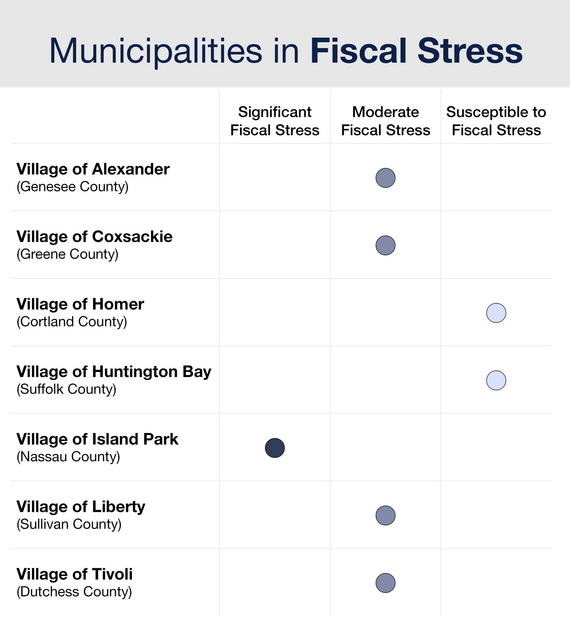
On March 21, 2026, New York State Comptroller Thomas P. DiNapoli announced that seven villages were designated in fiscal stress under his office’s Fiscal Stress Monitoring System (FSMS) for their fiscal year ending in 2025. DiNapoli’s office evaluated all non-calendar fiscal year local governments that filed their annual financial reports (AFR) in time to be scored. One village was designated in “significant fiscal stress,” four in “moderate fiscal stress,” and two as “susceptible to fiscal stress.”
The Village of Island Park (Nassau County) was classified in “significant fiscal stress.” The four villages designated in “moderate fiscal stress” were: Alexander (Genesee County), Coxsackie (Greene), Liberty (Sullivan) and Tivoli (Dutchess). The two villages classified as “susceptible to fiscal stress” were: Homer (Cortland) and Huntington Bay (Suffolk).
“The number of local governments with a fiscal stress designation remains low, but many cannot be evaluated because they do not file their required annual financial reports in time to be scored,” DiNapoli said. “A gap in filing is in itself a risk and creates a missed opportunity to identify fiscal stress and take corrective action before more drastic steps are needed. With uncertainty coming out of Washington having the potential to affect state and local funding and the economy, officials must closely monitor their financial condition to be able to adjust to changes that may lie ahead. I encourage local governments to use our self-assessment tool to help them budget and avoid pitfalls.”
The latest round of fiscal scores are for local governments with fiscal years ending between Feb. 28 and July 31, 2025, including 518 villages, most of which have a fiscal year ending on May 31. The scores, which are based on self-reported data, also cover 17 cities with non-calendar fiscal years, including the “Big 4” cities of Buffalo, Rochester, Syracuse and Yonkers, each of which have fiscal years ending on June 30.

Local governments are statutorily required to file an AFR with DiNapoli’s office following the close of their fiscal year. In total, 101, or almost 20% of local governments did not file their AFR in time to receive a FSMS score, a date that is at least three months past their statutory filing deadline. Over 386,000 New Yorkers reside in these municipalities.
Notably, three villages did not file in time to receive a score for 2025 and were in stress in fiscal year 2024: Saugerties (Ulster), Washingtonville (Orange) and Kaser (Rockland). The number of non-filers with non-calendar fiscal years has doubled since 2014.
DiNapoli’s office continues an outreach campaign to remind local officials of the statutory filing deadlines and provide assistance as needed and recently launched an online resource that highlights the importance of the AFR and tracks non-filers. It includes a tool for the public to check the filing status of any local government.
FSMS, which DiNapoli launched in 2012, assesses levels of fiscal stress in local governments using financial indicators including year-end fund balance, cash position, short-term cash-flow borrowing and patterns of operating deficits. It generates overall fiscal stress scores, which ultimately determine designations. The system also separately analyzes environmental indicators to provide insight about local economies and other challenges that may affect a local government’s or school district’s finances. This information includes population trends, poverty and unemployment.
DiNapoli’s office provides a self-assessment tool that allows local officials to calculate fiscal stress scores based on current and future financial assumptions. Officials can use this tool to assist in budget planning, which is especially helpful during periods of revenue and expenditure fluctuations.
In January, DiNapoli released fiscal stress scores for school districts. In September, his office will release scores for municipalities with a calendar-year fiscal year, which includes counties, towns, most cities and a few villages.
List of Villages and Cities in Fiscal Stress
Municipalities in Fiscal Stress
List of Villages and Cities that Failed to File Financial Information
Municipalities that Failed to File or Inconclusive List
Complete List of Fiscal Stress Scores
Data Files
FSMS Search Tool
Tool
AFR Non-Filers
Webpage Tracker Tool
Mar 21, 2026
Selected items from blogs posted on the Internet during the week ending March 20, 2026
CALL FOR ENTRIES for the AI 50 Awards 2026! The Center for Public Sector AI invites all US state, local, and tribal governments, education and nonprofit entities, as well as private industry partners, that are advancing artificial intelligence, to participate in the AI 50 Awards 2026. Submissions are due April 10. LEARN MORE
4 Ways Government Organizations Are Driving Efficiency Government and education organizations are under growing pressure to do more with fewer resources. This thought leadership white paper explores four proven ways SLED organizations are driving efficiency through modernization, from process mapping and AI-powered automation to cloud adoption and improved constituent experiences. DOWNLOAD
Mar 20, 2026
SUNY Research Webinar highlighting the women who shaped New York State’s past and continue to inspire its future
Join the SUNY Research Foundation Webinar on Wednesday, March 25, 2026 highlighting the women who shaped New York State’s past and continue to inspire its future. Hear from the Radley Fellows as they share their groundbreaking research.
This event honors the vision of Dr. Virginia Radley, whose fellowship uplifts SUNY scholars exploring women’s leadership, the humanities, and inclusive civic impact.
Register today at https://ow.ly/6y6C50YwwLW
New York State Comptroller releases local government audits
On March 19, 2026 New York State Comptroller Thomas P. DiNapoli issued the local government audits described below.
Click on the text highlighted in color to access the text of the audits.
Village of Asharoken – Claims Audit and Treasurer’s Duties (Suffolk County) Auditors found the board did not always conduct a thorough audit of individual claims for non-payroll disbursements because supporting documentation was not consistently included with claims submitted for review. Of the 232 disbursements totaling $877,625 reviewed, 51 disbursements totaling $69,707 were not properly audited due to missing invoices, unsigned vouchers, late fees and claims that showed no evidence of board review. Auditors also found that some payments were withdrawn directly from the village’s bank account without being audited by the board.
Town of Gorham – Distribution of Foreign Fire Insurance Tax Proceeds (Ontario County) Town officials did not properly distribute the 2023 and 2024 Foreign Fire Insurance tax proceeds in accordance with state law and relevant case law. The bookkeeper incorrectly calculated the allocation by using an inaccurate formula that included the fire district and based the distribution on contract payments and budgeted appropriations rather than the number of active members in the fire companies. Auditors determined that the fire district should not have been included in the calculation and that the proceeds should have been distributed based on a pro-rata formula using active membership totals. As a result, one fire department received $681 more than its share, another received $4,076 less than its share and the fire district improperly received $3,395. In addition, town officials did not review the allocation calculations to ensure the funds were accurately distributed.
Fairview Fire District – Procurement and Claims Audit (Dutchess County) The board and district officials did not always procure goods and services in a cost-effective manner or ensure claims were properly audited for accuracy and completeness. As a result, officials could not support the district procuring a $1.2 million ladder truck in the most cost-effective manner and did not pursue competition or document the competitive process for 11 purchases totaling $178,347 out of 18 purchases totaling $414,458. In addition, officials did not effectively audit 50 claims totaling $124,600, made 15 purchases totaling $5,784 that were not appropriate because they were gifts and did not approve reimbursement payments to 27 employees totaling $19,419.
Preston Fire District – Board Oversight (Chenango County) The board did not provide proper oversight of the district’s financial activities. The board did not adopt an investment policy, correctly monitor investments, establish a procurement policy, effectively audit claims, annually audit the treasurer’s records or ensure the district’s annual financial reports were filed in a timely manner. Although the district’s investments were legal, safe and liquid, officials maintained the capital reserve fund in a savings account earning 0.02% interest and realized only $125 in earnings during the three completed fiscal years of the audit period. If officials invested in an alternative permissible investment, such as treasury bills with an average interest rate of 3.89%, the district could have realized approximately $26,000 in additional earnings during the same period.
Town of Ridgeway – Health Insurance Benefits (Orleans County) Auditors found the board did not properly authorize or monitor health insurance benefits provided to current and former officials. Because internal controls and oversight were not established, the supervisor did not ensure officials were eligible to receive post-employment health insurance benefits or that required premium contributions were paid to the town. As a result, the town incurred $236,885 more for health insurance premiums than it should have during the audit period, representing approximately 34% of the town’s total health insurance premiums over the seven-year period. In addition, the supervisor did not ensure certain former officials were eligible for benefits, resulting in $179,325 in unauthorized payments, and did not collect $52,659 in required premium contributions owed to the town.
Middlesex Fire District – Procurement (Yates County) District officials did not ensure that goods and services were procured in an economical manner. These deficiencies occurred because officials did not follow the procurement policy adopted by the board of fire commissioners or demonstrate that the emergency exception to competitive bidding applied when purchasing a new tanker truck. As a result, officials did not competitively bid and awarded a contract valued at $564,065 to purchase the tanker truck. In addition, officials did not seek competition by obtaining verbal or written quotes for 14 purchases totaling $82,727, which reduced assurance that purchases were made in the most prudent and economical manner and in the district’s best interest.
Middlesex Fire District – Fiscal Transparency (Yates County) The treasurer prepared and provided monthly and annual financial reports to the board. However, the treasurer did not prepare and file the district’s annual financial reports with the Office of the State Comptroller (OSC) in a timely manner for fiscal years 2018 through 2024. The treasurer indicated that the former treasurer’s records were disorganized and incomplete and that she did not initially have access to the OSC’s online portal to file the reports.
Town of Marathon – Transparency of Fiscal Activities (Cortland County) The board did not conduct or provide for an annual audit of the supervisor’s financial records and reports for fiscal year 2024 in accordance with state law. In addition, the supervisor did not prepare and file the 2023 and 2024 annual financial reports with OSC and did not provide the board with complete monthly financial reports. The supervisor also did not properly maintain accounting records, record the dates cash receipts were collected or properly reconcile bank accounts and cash records.
Town of Coventry – Transparency of Fiscal Activities (Chenango County) The board did not conduct or provide for an annual audit of the supervisor’s financial records and reports for fiscal year 2024 in accordance with state law. In addition, the supervisor did not prepare and file the town’s annual financial reports for fiscal years 2022 through 2024 with OSC and did not provide the board with sufficient financial information to monitor the town’s fiscal activities. Auditors also found that the supervisor did not ensure debit card purchases were approved by the board, review payroll reports or provide the board with monthly budget status reports.
###
Mar 19, 2026
An appeal to the Commissioner of Education pursuant to Education Law §310 is appellate in nature and is not ripe for review by the Commissioner until the decision is final
Petitioner filed an appeal pursuant to Education Law §310 with New York State's Commissioner of Education concerning an action of the Board of Education of a school district [Respondent] involving its filling an administrative position [Coordinator Position] for which the Petitioner had earlier applied and had been interviewed.
In the instant appeal Petitioner alleged Respondent "declined to hire him for the vacant Coordinator Position in retaliation for, among other things, multiple lawsuits he commenced against a member of Respondent’s hiring committee. In addition, Petitioner alleged that Respondent had violated certain provisions of New York State's Constitution, certain provisions of New York State's Civil Service Law, and board policy.
Respondent had posted a job announcement for the Coordinator Position and subsequently reposted the job announcement in which it stated that "previous applicants need not reapply" but was otherwise identical to the previous posting.
Citing Appeal of Frey, 57 Ed Dept Rep, Decision No. 17,308, and other decisions of the Commissioner of Education, the Commissioner said Petitioner's appeal "must be dismissed as premature as the Commissioner will not render an advisory opinion on an issue before it becomes justiciable".
The Commissioner explained the Commissioner’s jurisdiction under color of Education Law §310 is appellate in nature and an action is not ripe for review by the Commissioner until it is final and results in an actual, concrete injury.
Noting that Respondent’s Policy 9240 requires that an interview committee recommend three or more candidates for second round interviews for administrative positions such as the Coordinator Position and Respondent had reposted the Coordinator Position:
1. In an effort to obtain the requisite number of candidates;
2. At the time Petitioner's appeal was filled Respondent indicated that “none of the candidates … interviewed at the first-level were rejected; and
3. Petitioner had not submitted a reply or otherwise contested these assertions by the Respondent;
the Commissioner found that Petitioner's appeal must be dismissed as premature.
The Commissioner also observed that to the extent Petitioner suggests that Respondent was required to conduct "a competitive examination of merit and fitness" to fill the Coordinator Position, such examinations are not required for positions such as the Coordinator Position as the duties of the positions involve “the function of administration of teaching” and dismissed Petitioner's appeal.
Click HERE to access the Commissioner of Education's decision posted on the Internet.
Mar 18, 2026
Challenging a New York State statute alleged to be unconstitutionally vague and overbroad
Executive Law §70-b established the Office of Special Investigation [OSI] within Office of the Attorney General [Respondent] to "investigate and, if warranted, prosecute" any alleged offense by a peace officer or police officer, "whether or not formally on duty", concerning any incident in which the death of a person, "whether in custody or not, is caused by an act or omission of such police officer or peace officer or in which the attorney general determines there is a question as to whether the death was in fact caused by an act or omission of such police officer or peace officer".
An off-duty state trooper was driving his private vehicle when another vehicle crossed over the center line of a highway and struck the trooper's vehicle head on. The trooper and a passenger were seriously injured and the driver of the other vehicle died. This triggered an investigation by OSI* pursuant to Executive Law §70-b.
The Police Benevolent Association of the New York State Troopers, Inc. [PBA], contending that Executive Law "§70-b was unconstitutionally vague and overbroad", brought an action challenging the statute.
Supreme Court granted Respondent's motion to dismiss PBA's complaint "for lack of standing" and PBA appealed the Supreme Court's ruling. In the course of the appeal Respondent conceded that PBA had standing to bring the action and asked the Appellate Division to address the merits of PBA's allegations. The Appellate Division declined Respondent's request and remitted the case to Supreme Court to allow Respondent to serve an answer to PBA's complaint.
Following remittal and service of Respondent's answer, Supreme Court granted Respondent's motion for summary judgment dismissing the complaint and granted, among other things, a declaratory judgment in Respondent's favor, holding that Executive Law §70-b is not void for vagueness and overbreadth. PBA appealed the Supreme Court's decision.
Addressing PBA's contention that Executive Law §70-b is unconstitutionally vague and overbroad, the Appellate Division, citing White v Cuomo, 38 NY3d 209, said "It is well settled that legislative enactments are entitled to a strong presumption of constitutionality, and courts strike them down only as a last unavoidable result after every reasonable mode of reconciliation of the statute with the Constitution has been resorted to, and reconciliation has been found impossible". The Court then noted that "To rebut that presumption, the party attempting to strike down a statute as facially unconstitutional bears the heavy burden of proving beyond a reasonable doubt that the statute is in conflict with the Constitution", explaining that "A statute, or a regulation, is unconstitutionally vague if it fails to provide a person of ordinary intelligence with a reasonable opportunity to know what is prohibited, and it is written in a manner that permits or encourages arbitrary or discriminatory enforcement".
Concluding that PBA "has not met its heavy burden of demonstrating that the statute is unconstitutionally void on its face", the Appellate Division opined that PBA's conclusory assertion that Executive Law §70-b is constitutionally overbroad lacks merit as it does not infringe on any constitutionally protected conduct.
* In a footnote to its decision in the instant matter the Appellate Division observed that after an initial investigation OSI found that the underlying incident involving the death of the driver was not under the jurisdiction of Respondent's office because the death of the driver of the other vehicle was not caused by a police officer.