ARTIFICIAL INTELLIGENCE [AI] IS NOT USED IN COMPOSING NYPPL SUMMARIES OF JUDICIAL AND QUASI-JUDICIAL DECISIONS.

Jul 16, 2026

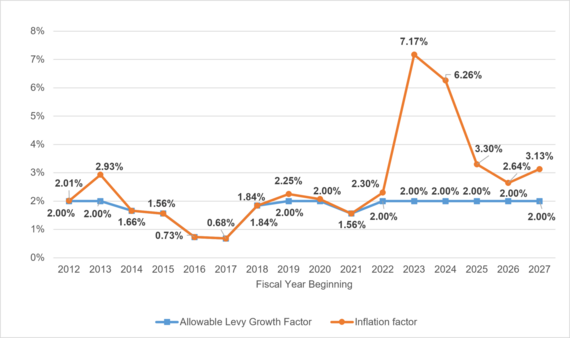
New York State Comptroller announces the New York State Tax Cap will remain at 2% for 2027

On July 15, 2026 New York State Comptroller Thomas P. DiNapoli announce New York State's 2027 property tax level will capped at 2% for local governments that operate on a calendar-based fiscal year according to data released today by State Comptroller DiNapoli. This figure affects tax cap calculations for all counties, towns and fire districts, as well as 44 cities and 13 villages.

"For the sixth consecutive year, the allowable tax levy growth will be limited to 2%," DiNapoli said. “Local governments are tasked with the difficult challenge of delivering essential services efficiently while managing higher costs of goods and services, as well as the persistent threat of destabilizing federal actions. My office offers technical assistance for those that need it and provides transparency to the public so they understand the fiscal pressures facing local governments.”

In accordance with state law, DiNapoli’s office calculated the 2027 inflation factor at 3.13% for those local governments with a calendar fiscal year, above the 2% allowable levy increase.

The tax cap, which first applied to local governments (excluding New York City) and school districts in 2012, limits annual tax levy increases to the lesser of the inflation factor or 2% with certain exceptions. The law, however, includes a provision that allows municipalities to override the cap.

Inflation & ALGF July 2026


Chart
Allowable Tax Levy Growth Factors for Local Governments

Related Work
Technical Assistance/Local Training Page

Fiscal Stress Monitoring System

Bookmark and Share


Jul 15, 2026

Challenging New York City’s congestion-pricing program for vehicles entering its business district in Midtown and Lower Manhattan

Two New York counties—Rockland and Orange [Plaintiffs]—sued the Triborough Bridge and Tunnel Authority and the Metropolitan Transportation Authority, [Defendants] alleging that New York City’s congestion-pricing program imposed an unauthorized tax, unconstitutionally restricted the right to travel, and violated the Due Process, Equal Protection, and Excessive Fines Clauses of New York State's and the U.S. Constitution. The district court granted Defendants’ motion to dismiss for failure to state a claim.

United States Court of Appeals for the Second Circuit summarized its decision in the instant appeal challenging the District Court's ruling in County of Rockland v. Triborough Bridge & Tunnel Authority, as follows: 

New York City’s congestion-pricing program charges a toll for vehicles entering the Central Business District in Midtown and Lower Manhattan. Assuming without deciding that the toll is not a tax under New York law, the Second Circuit concluded that the District Court correctly dismissed causes of action, noting that Orange County failed to allege that congestion pricing violates the right to travel.

In the words of the Circuit Court, "The program does not create invidious distinctions among drivers or impose more than a minor restriction on the right to travel". 

Accordingly, the Circuit Court, observing that it had reviewed the unresolved issues the District Court's ruling "only for reasonableness", opined that Orange County failed to allege that the challenged toll is an unreasonable user fee, noted that:

1. Plaintiffs failed to state Due Process or Equal Protection claims because the congestion-pricing program is rationally related to New York’s legitimate interests in raising funds for mass transit and reducing vehicular congestion; and

2. "Rockland County does not plausibly allege that the toll is an unconstitutionally excessive fine".

Accordingly, the Second Circuit affirmed "the judgments of the district court".

Click HERE to access the Circuit Court's ruling posted on the Internet. 


Jul 14, 2026

Responding to a New York State Freedom of Information Law request

The Town received Plaintiff's Freedom of Information Law [FOIL] request and on the same day responded to the request by advising Plaintiff' that all of the requested records could be found in "permit files" on the Town's website. The Town then provided Plaintiff' with the appropriate the website's address, told Plaintiff how the website could be accessed via the Internet, and provided Plaintiff with information on how to access permit files via the Town's "public kiosk." The Town's letter to Plaintiff also indicated that "[Plaintiff's] FOIL [request] is now completed." 

Petitioner administratively appealed the Town's determination, but the Town did not respond and Petitioner commenced the instant CPLR Article 78.  

Supreme Court dismissed [1] Plaintiff's petition; [2] Plaintiff's application for an award of attorney's fees and litigation costs; and [3] Plaintiff's request for a judgment declaring that the Town acted unlawfully in withholding records from Plaintiff. Plaintiff appealed the Supreme Court's decision.

Observing that to promote open government and public accountability New York State'  FOIL "imposes a broad duty on government to make its records available to the public", the Appellate Division explained that "[w]hen faced with a FOIL request, an agency must either disclose the record sought, deny the request and claim a specific exemption to disclosure, or certify that it does not possess the requested document and that it could not be located after a diligent search".

Here, said the Appellate Division, the Supreme Court properly granted the Town's motion to dismiss that branch of Plaintiff's complaint which sought to compel the production of the "requested records" as the Town's FOIL response was not a denial but, in fact,  informed the Plaintiff how to locate the requested records either via the Town's website or in person.

The Appellate Division's decision also noted that "Although the Town referred the [Plaintiff] to a publicly available website, the [Plaintiff] did not request the records in any specific format" and  the Town was not required to certify that any requested records could not be found after diligent search as such a certification requirement is only triggered "when, in lieu of granting a FOIL request, the agency finds that it either does not possess the item requested or is unable to locate it after a diligent search".

Here the records requested were always available to the Plaintiff, who was so advised  prior to the commencement of the Plaintiff's instant CPLR Article 78 proceeding and thus the litigation "did not trigger the production of such records". 

Accordingly, the Appellate Division found that Plaintiff was not entitled to discretionary fees pursuant to Public Officers Law §89(4)(c)(i) "because even though Plaintiff administratively appealed the Town's FOIL determination and the Town did not provide a response, there was nothing to administratively appeal, as the Town did not deny the Plaintiff's FOIL request".

Click HERE to access the Appellate Division's decision posted on the Internet.

Editor in Chief Harvey Randall served as Director of Personnel, State University of New York Central Administration; Director of Research, Governor's Office of Employee Relations; Principal Attorney, Counsel's Office, New York State Department of Civil Service; and Colonel, JAG, Command Headquarters, New York Guard. Consistent with the Declaration of Principles jointly adopted by a Committee of the American Bar Association and a Committee of Publishers and Associations, the material posted to this blog is presented with the understanding that neither the publisher nor NYPPL and, or, its staff and contributors are providing legal advice to the reader and in the event legal or other expert assistance is needed, the reader is urged to seek such advice from a knowledgeable professional.

CAUTION

Subsequent court and administrative rulings, or changes to laws, rules and regulations may have modified or clarified or vacated or reversed the information and, or, decisions summarized in NYPPL. For example, New York State Department of Civil Service's Advisory Memorandum 24-08 reflects changes required as the result of certain amendments to §72 of the New York State Civil Service Law to take effect January 1, 2025 [See Chapter 306 of the Laws of 2024]. Advisory Memorandum 24-08 in PDF format is posted on the Internet at https://www.cs.ny.gov/ssd/pdf/AM24-08Combined.pdf. Accordingly, the information and case summaries should be Shepardized® or otherwise checked to make certain that the most recent information is being considered by the reader.
THE MATERIAL ON THIS WEBSITE IS FOR INFORMATION ONLY. AGAIN, CHANGES IN LAWS, RULES, REGULATIONS AND NEW COURT AND ADMINISTRATIVE DECISIONS MAY AFFECT THE ACCURACY OF THE INFORMATION PROVIDED IN THIS LAWBLOG. THE MATERIAL PRESENTED IS NOT LEGAL ADVICE AND THE USE OF ANY MATERIAL POSTED ON THIS WEBSITE, OR CORRESPONDENCE CONCERNING SUCH MATERIAL, DOES NOT CREATE AN ATTORNEY-CLIENT RELATIONSHIP.
New York Public Personnel Law. Email: publications@nycap.rr.com