ARTIFICIAL INTELLIGENCE [AI] IS NOT USED IN COMPOSING NYPPL SUMMARIES OF JUDICIAL AND QUASI-JUDICIAL DECISIONS.

May 24, 2025

Selected reports issued by New York State Comptroller Thomas P. DiNapoli during the week ending May 23, 2025

DiNAPOLI RELEASES GUIDE TO FEDERAL FUNDING IN NEW YORK


Click on the text highlighted in color to access the full report.

A new online resource released by New York State Comptroller Thomas P. DiNapoli details the vast array of services that federal funding supports amid the continued uncertainty in Washington over potential cuts for states, including funds for Medicaid and other health programs, education, social welfare, transportation, public protection, environment and other vital programs.

“Actions taken in Washington to cut health care, food assistance, infrastructure and other critical programs will harm New Yorkers,” DiNapoli said. “Major cuts will reduce the services the state provides that simply cannot be replaced by state taxpayers. Understanding how New Yorkers are served by federal dollars will be essential in seeing how future changes to federal spending will impact our residents and communities."

DiNapoli’s guide presents federal revenues in the state budget and federal support of the state’s safety net programs, which help New Yorkers from their youngest years in childcare and K-12 education through their senior years with Social Security benefits. In addition, the new tool provides spending by major funding streams and functions, including grants for various Medicaid programs, clean water, and children’s health insurance programs. It also includes a county-by-county breakdown in enrollment and benefits for programs like Medicaid, Social Security, housing assistance, and the Supplemental Nutrition Program for Women, Infants and Children.

Insights include:

  • The state received $96.7 billion in federal dollars in state fiscal year (SFY) 2025, representing more than 38% of the $249 billion in revenue received by New York in that fiscal year.
  • Nearly 3 million New Yorkers rely on the Supplemental Nutrition Assistance Program (SNAP), the nation’s largest food assistance program.
  • Nearly 9,000 (4.7%) members of the state’s workforce are backed by federal funding, with the share significantly higher in some agencies, such as 83% at the Department of Labor.
  • Over 3.7 million New York residents received Social Security benefits in 2023.
  • Over 150,000 children received childcare assistance funded primarily by the federal government.
  • More than one-third of residents are on Medicaid in eight counties: Bronx, Chemung, Kings, Montgomery, Queens, Richmond, Rockland and Sullivan.
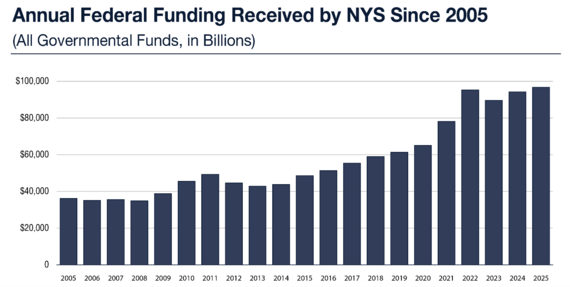
Federal Funding

DiNapoli has released multiple reports this year highlighting the relationship between the state and the federal government, including his annual balance of payments report, and analysis of the 2017 Tax Cuts and Jobs Act.

The online guide will be expanded with additional analysis and reports as federal actions become more concrete.

Online Tool
Federal Funding in New York

Other Resources
New York’s Balance of Payments in the Federal Budget
Series of Briefs Tracking New York City Federal Funding

###


 DiNAPOLI RELEASES MUNICIPAL AUDITS

                 Click on the text highlighted in color to access the full report.

Fairview Fire District – Financial Operations (Dutchess County)

The board and district officials did not properly manage and oversee the district’s financial operations and were not transparent. Auditors found limited assurance that the information used by the board and district officials to make financial decisions was accurate and complete. Taxpayers had limited access to financial information to help ensure they could make informed decisions related to district operations. The board improperly assigned the duties of the district treasurer to an independent contractor. Unrealistic budgets increased the burden placed on taxpayers and resulted in the district’s reserve funds, in total, increasing by approximately $1.5 million (84%) over the last five fiscal years. Board meeting minutes did not always contain complete information on formal board actions and were not made available for public review in a timely manner.


Town of Saugerties – Claims Auditing (Ulster County)

The board did not properly audit claims or authorize credit card purchases. Auditors reviewed 50 claims, totaling $2.1 million and 50 credit card purchases, totaling $28,815. Fifteen purchases, totaling $91,979, did not comply with the town’s purchasing policy. For example, town officials paid a contractor $46,500 to clear debris for the highway department without competitive bidding or documentation that it was exempt. Auditors also found 36 credit card purchases, totaling $10,868, that were not properly authorized, including an unauthorized individual who used the town supervisor's credit card to make a purchase without the supervisor's knowledge. The equipment purchased was then shipped to the town’s former video supply contractor. The supervisor was unable to verify whether the town received this purchase due to the lack of supporting documentation. Also, the supervisor used a town credit card to pay for lunch to celebrate an employee’s birthday, which is not an appropriate use of taxpayer money.


Rhinecliff Fire District – Board Oversight (Dutchess County)

The board did not adequately provide oversight of financial operations, hindering its ability to make informed financial decisions and assure taxpayers that the district’s financial activities were adequately accounted for and reported. The board did not complete mandated financial oversight training or ensure proper accounting records were maintained. The board did not make certain required annual financial information was filed with the State Comptroller’s office since 2009. It did not ensure bank reconciliations were performed, conduct an annual audit of the secretary-treasurer’s records or develop and adopt written multiyear financial and capital plans, among other issues.


City of Amsterdam – Budget Review (Montgomery County)

The significant revenue and expenditure projections in the 2025-26 proposed budget are reasonable. However, auditors identified certain revenue and expenditure projections and other matters that should be reviewed. Auditors noted the mayor submitted the 2025-26 proposed budget to the council on May 6, 2025, or 35 days after the charter-established deadline. The proposed budget for the recreation fund is not structurally balanced because it includes a subsidy from the general fund to finance its operations. The proposed budget for the water fund does not include appropriations for real property taxes that will be owed to local governments and school districts for properties that the city owns outside of Amsterdam for the purpose of supplying water to the city. The proposed budget allocates appropriations for personal services, contractual expenditures and employee benefits between the operating funds using unsupported allocation methods. The city’s proposed budget includes a tax levy of $6,378,809, which is within the legal limit.

###


FORMER HANNIBAL FIRE CHIEF PLEADS GUILTY TO STEALING FROM FIRE COMPANY

Former Hannibal Fire Chief Chris Emmons pleaded guilty today to Grand Larceny for stealing from the town’s fire company and agreed to pay $9,838 in restitution, State Comptroller Thomas P. DiNapoli, Oswego County District Attorney Anthony J. DiMartino, Jr., and New York State Police Superintendent Steven G. James announced.

“Mr. Emmons diverted money meant to protect his community to fund his own interests by deceiving the fire company that it would receive the proceeds,” DiNapoli said. “Emmons betrayed not only the company but all who rely upon it. I thank District Attorney DiMartino and Superintendent James for their continued partnership and ensuring Emmons was held accountable.”

“The Oswego County District Attorney’s office thanks the New York State Police and the New York State Comptroller’s Office for their assistance in this matter,” District Attorney DiMartino, Jr. said. “With the concerted efforts of these agencies, we achieved a just and proper result. The defendant will immediately be required to pay restitution for the monies he deprived from the Hannibal Fire Company as determined by the Comptroller’s audit, as well as community service and supervision. This conduct will never be tolerated and will be prosecuted to deter such similar illegal conduct.”

“Mr. Emmons’ guilty plea illustrates the duplicity he presented to cheat the fire company out of its rightful funds,” Superintendent James said. “The disruption of this act serves as a reminder that we will not tolerate those who choose to profit from this activity. We will continue to partner with the Comptroller’s Office and the Oswego County District Attorney’s Office to hold those who defraud public sector organizations accountable.”

Emmons used the Hannibal Fire Company’s funds to build a go-kart track, Hannibal Kartway, claiming that its proceeds would benefit the company. Emmons, his family and others ran the track for five years, from 2017 to 2022, until an audit by DiNapoli’s office discovered discrepancies in the track’s books. A subsequent investigation found that rather than turning the money over to the company, Emmons had pocketed the Kartway’s profits. The investigation also found that Emmon’s father, Carl Emmons Sr., closed the Kartway’s bank account upon learning of the Comptroller’s examination and the remaining funds were transferred to his bank account. Carl Emmons Sr. faces pending charges of Grand Larceny in the fourth degree.

Chris Emmons pleaded guilty before Judge Karen Brandt Brown of Oswego County Court. He is scheduled to appear again on May 22, 2026.

###


DiNAPOLI: SYRACUSE MAN PLEADS GUILTY TO STEALING NEARLY $22,000 IN PENSION CHECKS SENT TO HIS DECEASED MOTHER

A Syracuse man pleaded guilty yesterday to stealing nearly $22,000 in pension payments sent to his deceased mother, State Comptroller Thomas P. DiNapoli, Onondaga County District Attorney William J. Fitzpatrick and New York State Police Superintendent Steven G. James announced. The defendant, Michael Glinski, 45, was arrested in January 2025 following an investigation by DiNapoli’s office.

“Mr. Glinski tried to hide his mother’s death to cash her pension checks. Attempts to steal from and defraud our pension system will be rooted out,” DiNapoli said. “My thanks to DA Fitzpatrick and Superintendent James for their partnership in holding the defendant accountable.”

James said, “I commend our State Police members and partners from the State Comptroller’s Office for their devoted work on this investigation. Mr. Glinski knowingly defrauded the New York State pension system, taking benefits from those who rightfully earned them. The State Police will continue to work with our law enforcement partners to hold accountable individuals who mistakenly think they can get away with these crimes.”

Glinski’s mother, a clerk with the Village of Solvay Police Department, retired in August of 2014 and received a monthly pension check. She also received her deceased husband’s pension payment as a beneficiary since 2019. When she passed away in October 2021, both payments should have stopped, but the New York State and Local Retirement System was not notified of her death until July 2022. Her payments then stopped, and an investigation was launched. 

DiNapoli’s investigators determined that Glinski had deposited 17 pension checks, totaling $21,946.36, into his personal bank account by endorsing the checks using his power of attorney, which he knew had ended under the law at the time of his mother’s death.    

Glinski pleaded guilty to grand larceny in the third degree in Onondaga County Court before Judge Mary Anne Doherty. He is due back in court on June 23.

###

Since taking office in 2007, DiNapoli has committed to fighting public corruption and encourages the public to help fight fraud and abuse. New Yorkers can report allegations of fraud involving taxpayer money by calling the toll-free Fraud Hotline at 1-888-672-4555, by emailing a complaint to investigations@osc.ny.gov or by mailing a complaint to: Office of the State Comptroller, Division of Investigations, 8th Floor, 110 State St., Albany, NY 12236.


May 23, 2025

In an effort to vacate an arbitration award the burden is on the petitioner to establish grounds for vacatur by clear and convincing evidence

The petitioner, Nassau County Sheriff's Correction Officers Benevolent Association, Inc. [Union], and Nassau County [Respondent], entered into a collective bargaining agreement [CBA] that was effective from January 1, 1998, through December 31, 2004. Although the CBA expired, many of its terms, including the particular provision presently at issue in this CPLR Article 75 action  remained in effect.

The Union filed a grievance asserting that the County had violated a provision of the CBA when it declined to credit negotiating unit members credit compensatory time off for  who were required to report to work while other negotiating unit members were directed to stay home due to COVID-19 exposure during a state of emergency declared by the County in response to the COVID-19 pandemic. Ultimately the matter was submitted to arbitration. 

After a hearing, the arbitrator issued an award denying the the Union's grievance. The arbitrator determined that the County had not violated relevant section of the CBA because that provision did not apply in the instant circumstance. The Union challenged the arbitration award and  commenced a CPLR Article 75 proceeding seeking to vacate the arbitration award. Supreme Court "denied the Union's petition, confirmed the arbitration award, and, in effect, dismissed the proceeding". The Union appealed the Supreme Court's decision.

The Appellate Division, citing Matter of Long Beach Professional Firefighters Assn. v City of Long Beach, 214 AD3d at 736-737, noted that the burden is on the petitioner "to establish grounds for vacatur by clear and convincing evidence" as  "Courts may vacate an arbitrator's award only on the grounds stated in CPLR 7511(b)". Pointing out that the Union only claimed that the arbitrator "exceeded his power", the Appellate Division opined that "Such an excess of power occurs only where the arbitrator's award violates a strong public policy, is irrational or clearly exceeds a specifically enumerated limitation on the arbitrator's power".

Further, the opinion notes that "'Courts are bound by an arbitrator's factual findings, interpretation of the contract and judgment concerning remedies" and cannot  examine the merits of an arbitration award nor substitute its judgment for that of the arbitrator simply because it believes its interpretation would be the better one.

 Contrary to the Union's contention, the Appellate Division held that the arbitration award, which rested upon the arbitrator's interpretation of the CBA, was supported by the record, was not irrational, and did not rewrite the terms of the CBA. 

Finding that the Union failed to demonstrate by clear and convincing evidence that the arbitration award should be vacated on the ground that it was irrational and "An arbitration award is irrational only where there is no evidence whatever to justify the award, or where the award gave a completely irrational construction to the provisions in dispute and, in effect, made a new contract for the parties", the Appellate Division concluded that Supreme Court properly denied the Union's petition, confirmed the arbitration award, and, in effect, dismissed the proceeding."

Click HERE to access the Appellate Division's decision posted on the Internet.


May 22, 2025

New York City Office of Administrative Trials and Hearings Administrative Law Judge recommended Appointing Authority dismiss of all disciplinary charges filed against employee

ALJ Christine Stecura recommended dismissal of charges against Respondent, a correction officer, after Petitioner failed to prove that Respondent had engaged in undue familiarity with detainees. 

Petitioner, the Department of Correction, brought disciplinary charges against Respondent, an investigator with the Correction Intelligence Bureau (“CIB”), for allegedly standing by a partially obscured open cell door that blocked her from camera view while speaking to detainees, giving and receiving unidentified items to and from detainees, and using her cell phone in front of detainees. 

Petitioner relied on security camera footage, and testimony from an investigator and an assistant deputy warden in charge of CIB, to support its allegations. 

Respondent did not dispute that she spoke with detainees at length in the housing areas or used her cell phone in front of detainees but argued that her conduct was related to her work duties as a CIB investigator, which requires speaking with detainees to build rapport and gain intelligence. Testimony from the retired warden of the facility and the assistant deputy warden in charge of CIB bolstered Respondent’s testimony. 

Regarding the allegation that Respondent gave and received unidentified items from detainees, the ALJ concluded that the video evidence showed Respondent passing a paper bag out of camera view to detainees standing behind a cell door. It also showed Respondent on another occasion removing a bag from her pocket, moving it out of camera view behind a cell door, and then returning the bag to her pocket. 

However, Petitioner failed to show that in either instance impermissible items were given or received, or that Respondent’s actions violated security procedures. 

Accordingly, the ALJ recommended dismissal of all charges against Respondent. 

Click HERE to access Judge Stecura's findings and recommendation posted on the Internet.


May 21, 2025

Plaintiff is not required to exhaust administrative remedies when the cause of action by the plaintiff is not controlled by a provision in a collective bargaining agreement

In an action to recover damages pursuant to Civil Service Law §75-b and for alleged  employment discrimination on the basis of gender and disability, a Plaintiff employed by the New York City Police Department [NYPD] contended the City of New York and NYPD acted in violation of the New York State Human Rights Law (Executive Law Article 15) and the New York City Human Rights Law (Administrative Code of City of NY § 8-101 et seq.).

The City of New York moved, among other things, to dismiss certain causes of action asserted it. Supreme Court granted those branches of the City's motion and Plaintiff appealed.

The Appellate Division held that:

1. "On a motion to dismiss a complaint pursuant to CPLR 3211(a)(7), the court must accept the facts alleged by the plaintiff as true and liberally construe the complaint, according it the benefit of every possible favorable inference";

2. Citing NFA Group v Lotus Research, Inc., 180 AD3d 1060, the Court noted that "[e]videntiary material submitted by the plaintiff in opposition to such a motion may be considered to remedy defects in the complaint"; and

3. "An employee covered by a collective bargaining agreement which provides for a grievance procedure must exhaust administrative remedies prior to seeking judicial remedies".

However, opined the Appellate Division "[t]here is no need to exhaust administrative remedies when the cause of action by the plaintiff is not governed by the [collective bargaining agreement]". 

In the instant appeal the Appellate Division, citing Flynn v New York State Dept. of Corr. & Community Supervision, 201 AD3d at 886, observed "the [Plaintiff] is not alleging that the City violated a provision of the applicable collective bargaining agreement, but rather that the City took an adverse personnel action against her in retaliation for a disclosure protected under Civil Service Law §75-b(2)(a),".

Accepting the facts as alleged in the complaint as true, and according Plaintiff "the benefit of every possible favorable inference", the Appellate Division concluded "Supreme Court should have denied that branch of the defendants' motion which was pursuant to CPLR 3211(a)(7) to dismiss so much of [Plaintiff's] second cause of action as alleged, in effect, a violation of Civil Service Law §75-b insofar as asserted against the City."

The Appellate Division's decision is set out below.


Warmbier v City of New York
2025 NY Slip Op 02810
Decided on May 7, 2025
Appellate Division, Second Department
Published by New York State Law Reporting Bureau pursuant to Judiciary Law § 431.
This opinion is uncorrected and subject to revision before publication in the Official Reports.


Decided on May 7, 2025 SUPREME COURT OF THE STATE OF NEW YORK Appellate Division, Second Judicial Department
ANGELA G. IANNACCI, J.P.
PAUL WOOTEN
BARRY E. WARHIT
CARL J. LANDICINO, JJ.

2023-10996
(Index No. 701224/22)

[*1]Grace Warmbier, appellant,

v

City of New York, respondents, et al., defendants.

Augello Law Group, P.C., New York, NY (Cynthia A. Augello of counsel), for appellant.

Muriel Goode-Trufant, Corporation Counsel, New York, NY (Melanie T. West and Chloé K. Moon of counsel), for respondent City of New York.

DECISION & ORDER

In an action, inter alia, in effect, to recover damages pursuant to Civil Service Law § 75-b and for employment discrimination on the basis of gender and disability, the plaintiff appeals from an order of the Supreme Court, Queens County (Kevin J. Kerrigan, J.), entered August 1, 2023. The order, insofar as appealed from, granted those branches of the motion of the defendants City of New York and New York City Police Department which were pursuant to CPLR 3211(a)(7) to dismiss the third through eighth causes of action and so much of the second cause of action as alleged, in effect, a violation of Civil Service Law § 75-b insofar as asserted against the defendant City of New York.

ORDERED that the order is modified, on the law, by deleting the provision thereof granting that branch of the motion of the defendants City of New York and New York City Police Department which was pursuant to CPLR 3211(a)(7) to dismiss so much of the second cause of action as alleged, in effect, a violation of Civil Service Law § 75-b insofar as asserted against the defendant City of New York, and substituting therefor a provision denying that branch of the motion; as so modified, the order is affirmed insofar as appealed from, without costs or disbursements.

The plaintiff was employed as a "Criminalist III" with the defendant New York City Police Department (hereinafter NYPD). In May 2022, the plaintiff commenced this action against the NYPD and the defendant City of New York (hereinafter together the defendants), among others, inter alia, in effect, to recover damages pursuant to Civil Service Law § 75-b and for employment discrimination on the basis of gender and disability in violation of the New York State Human Rights Law (Executive Law art 15) and the New York City Human Rights Law (Administrative Code of City of NY § 8-101 et seq.). The defendants moved, among other things, pursuant to CPLR 3211(a)(7) to dismiss the third through eighth causes of action and so much of the second cause of action as alleged, in effect, a violation of Civil Service Law § 75-b insofar as asserted against the City. In an order entered August 1, 2023, the Supreme Court, inter alia, granted those branches of the motion. The plaintiff appeals.

"On a motion to dismiss a complaint pursuant to CPLR 3211(a)(7), the court must accept the facts alleged by the plaintiff as true and liberally construe the complaint, according it the [*2]benefit of every possible favorable inference" (Dee v Rakower, 112 AD3d 204, 208; see 1470 39th St., LLC v Goldberg, 226 AD3d 853, 854). Further, "[e]videntiary material submitted by the plaintiff in opposition to such a motion may be considered to remedy defects in the complaint" (NFA Group v Lotus Research, Inc., 180 AD3d 1060, 1061).

Here, contrary to the City's contention, the plaintiff was not required to allege that she exhausted her administrative remedies under the applicable collective bargaining agreement prior to seeking relief pursuant to Civil Service Law § 75-b. "An employee covered by a collective bargaining agreement which provides for a grievance procedure must exhaust administrative remedies prior to seeking judicial remedies" (Shortt v City of New York, 173 AD3d 925, 926; see Flynn v New York State Dept. of Corr. & Community Supervision, 201 AD3d 885, 886). However, "[t]here is no need to exhaust administrative remedies when the cause of action by the plaintiff is not governed by the [collective bargaining agreement]" (Shortt v City of New York, 173 AD3d at 927; see Flynn v New York State Dept. of Corr. & Community Supervision, 201 AD3d at 886). Here, the plaintiff is not alleging that the City violated a provision of the applicable collective bargaining agreement, but rather that the City took an adverse personnel action against her in retaliation for a disclosure protected under Civil Service Law § 75-b(2)(a) (see Flynn v New York State Dept. of Corr. & Community Supervision, 201 AD3d at 886).

Further, accepting the facts as alleged in the complaint as true, and according the plaintiff the benefit of every possible favorable inference (see Leon v Martinez, 84 NY2d at 87-88), the complaint, together with the plaintiff's affidavit and evidence submitted in opposition to the motion, adequately stated a cause of action alleging a violation of Civil Service Law § 75-b. Accordingly, the Supreme Court should have denied that branch of the defendants' motion which was pursuant to CPLR 3211(a)(7) to dismiss so much of the second cause of action as alleged, in effect, a violation of Civil Service Law § 75-b insofar as asserted against the City.

However, accepting as true the facts alleged in the complaint, and according the plaintiff the benefit of every possible favorable inference (see Leon v Martinez, 84 NY2d 83, 87-88), the complaint, even as amplified by the plaintiff's submissions in opposition to the motion, failed to state causes of action to recover damages for employment discrimination, unlawful retaliation, or hostile work environment (see Ayers v Bloomberg, L.P., 203 AD3d 872Polite v Marquis Marriot Hotel, 195 AD3d 965, 967).

The plaintiff's remaining contention is without merit.

Accordingly, the Supreme Court properly granted those branches of the defendants' motion which were pursuant to CPLR 3211(a)(7) to dismiss the third through eighth causes of action insofar as asserted against the City.

IANNACCI, J.P., WOOTEN, WARHIT and LANDICINO, JJ., concur.

ENTER:

Darrell M. Joseph

Clerk of the Court


May 20, 2025

New York State Comptroller Thomas P. DiNapoli announced the following local government audits were issued on May 20, 2025

Click on text highlighted in color to access the full audit.

City of Middletown – Payroll and Leave Benefits (Orange County)

City officials did not accurately pay employees’ salaries, wages and benefits or properly accrue leave benefits. Auditors reviewed payments and benefits totaling $1.9 million and found exceptions totaling $292,205, including $191,253 in potential overpayments. As a result, the city paid employees for time they did not work or accrue. Two sewer treatment plant employees received $91,492 for time they may not have worked because they were working at another municipality. City officials made $99,761 in vacation buyout payments that were not in accordance with city collective bargaining agreements.


Town of Philipstown – Financial Management (Putnam County)

The board did not properly manage the town’s financial operations and used the town’s general fund to pay for the Garrison Landing Water District’s (GLWD’s) operation and maintenance costs. During the audit period, the town’s residents paid $2.4 million of the GLWD’s costs that only benefited taxpayers within the water district and resulted in the decline of the general fund balance from $1 million to $53,137. Specifically, the board did not appropriately budget for GLWD operations. Although the town had a GLWD water fund and budgeted approximately $20,000 for debt service in it, the board did not budget for GLWD appropriations in the general fund each year, where annual GLWD expenditures were funded and increased from $85,436 to $975,475 over the six-year audit period. The board did not adopt a transparent budget that clearly communicates the costs associated with GLWD operations or the associated funding sources to taxpayers. The board also did not adopt a comprehensive written multi-year financial plan to help guide the budget development process or establish funds to help finance future expenditures.


Town of Pleasant Valley – Financial Management (Dutchess County)

The board did not develop realistic budgets or properly manage reserves. As a result, the town had significant recurring operating surpluses and may have levied more taxes than necessary. From fiscal years 2019 through 2023, revenues were underestimated and expenditures were overestimated in the general and highway funds, generating operating surpluses totaling $5.1 million and $1.2 million, respectively. The board appropriated fund balance to offset annual deficits that was not needed to fund operations, including $439,870 in the general fund for the audit period and $603,395 in four of the five years reviewed for the highway fund. The board also accumulated surpluses resulting in unrestricted fund balances totaling $4.5 million and $2.4 million in the general and highway funds, respectively, as of Dec. 31, 2023. Because the board did not adopt a fund balance policy and lacked a plan on how the funds will be used, there was no rationale for accumulating significant fund balances.


Village of Leicester – Financial Management (Livingston County)

The board did not effectively manage the village’s fund balance or adopt realistic budgets.

Officials maintained unrestricted fund balance in the general and water funds totaling $729,709 and $152,143, respectively, at the end of the 2023-24 fiscal year, which was sufficient to fund the upcoming fiscal year’s budget appropriations for the general fund by nearly four times and for the water fund by more than half. The board also did not adopt a written fund balance policy or develop and adopt comprehensive written multi-year financial or capital plans that would have assisted the board and officials in developing and adopting realistic budgets and planning for the village’s financial future.


Caledonia Volunteer Fire Department, Inc. – Board Oversight (Livingston County)

The board did not provide adequate oversight of financial operations. In addition, the previous audit report, released March 2014, had similar findings and recommendations concerning the board’s lack of oversight. Because the board did not implement adequate corrective action to address these findings, the same deficiencies exist. The board did not ensure that the financial review committee conducted an annual review of the treasurer’s financial records or that all 325 claims paid between Jan. 1, 2023 and May 31, 2024, totaling $174,302, were reviewed, approved and properly supported. The board also did not ensure the treasurer maintained accurate and complete financial records or provided the board with adequate financial reports, bank statements, canceled check images and bank reconciliations to monitor operations. The board also did not ensure that officials safeguarded and properly supported hall rental and fundraising revenues. From Jan. 1, 2023 through May 31, 2024, deposits, including those for hall rentals and fundraising, totaled $211,917.


Employer failed to establish prima facie entitlement to summary judgment dismissing the complaint by failing to show it lacked constructive notice of the allegedly defective condition

Plaintiff, a teacher, alleged that she fell when she leaned on a defective desk as she was grading papers in a classroom. 

Supreme Court granted the Employer's motion for summary judgment dismissing Plaintiff's cause of action. The Appellate Division, however, unanimously reversed the Supreme Court's ruling "on the law", and reinstated Plaintiff's complaint. 

Although the Employer sustained its burden of establishing that it neither created nor had actual notice of the alleged defective desk, the Appellate Division held that Employer failed to establish prima facie entitlement to summary judgment dismissing the Plaintiff's complaint.

The Appellate Division explained that Employer did not show that the alleged defective condition did not exist when the area was last inspected prior to Plaintiff's fall. 

The Appellate Division's decision is set out below.


Mamah v New York City Dept. of Educ.
2025 NY Slip Op 02877
Decided on May 13, 2025
Appellate Division, First Department
Published by New York State Law Reporting Bureau pursuant to Judiciary Law § 431.
This opinion is uncorrected and subject to revision before publication in the Official Reports.


Decided and Entered: May 13, 2025
Before: Moulton, J.P., Kapnick, Scarpulla, Rodriguez, Higgitt, JJ.

Index No. 28148/19|Appeal No. 4355|Case No. 2024-02688|

[*1]Ramah Mamah, Plaintiff-Appellant,

v

The New York City Department of Education et al., Defendants-Respondents.

Godosky & Gentile, P.C., New York (Robert E. Godosky of counsel), for appellant.

Muriel Goode-Trufant, Corporation Counsel, New York (Karin Wolfe of counsel), for respondents.

Order, Supreme Court, Bronx County (Mitchell J. Danziger, J.), entered April 9, 2024, which granted defendants' motion for summary judgment dismissing the complaint, unanimously reversed, on the law, without costs, the motion denied, and the complaint reinstated.

Plaintiff, a teacher at a school in the Bronx, alleges that she fell when she leaned on a defective desk as she was grading papers in the back of a classroom. Defendants sustained their burden of establishing that they neither created nor had actual notice of the alleged defect by submitting the testimony of the school's custodian engineer stating that there had been no prior complaints or injuries related to the desk, and that there was no repair record of any desk because the school discarded broken desks and chairs. Plaintiff also testified that she was not aware of the defective desk leg until after her accident, and that none of the students who used the desk ever reported any defect to her (see Velocci v Stop & Shop, 188 AD3d 436, 439 [1st Dept 2020]).

Nevertheless, defendants failed to establish prima facie entitlement to summary judgment dismissing the complaint, as they did not sustain their burden of demonstrating that they lacked constructive notice of the allegedly defective condition. Although defendants relied on a daily logbook recording the custodian engineer's daily routine for the building, the logbook was not sufficient to show that defendants inspected the classrooms to ensure that they were free from defects (see Dan v City of New York, 227 AD3d 495, 496 [1st Dept 2024]). Furthermore, the custodian engineer testified at his deposition that although he inspected the classrooms every morning, he did so only to make sure that the heat was on. This testimony is insufficient to demonstrate defendants' lack of constructive notice, as it fails to show that the alleged condition did not exist when the area was last inspected before plaintiff fell (see Bonilla v 191 Realty Assoc., L.P., 125 AD3d 470, 470 [1st Dept 2015]).

THIS CONSTITUTES THE DECISION AND ORDER OF THE SUPREME COURT, APPELLATE DIVISION, FIRST DEPARTMENT.

ENTERED: May 13, 2025


May 19, 2025

A Government Artificial Intelligence [AI] Webinar Roundup

Catch up on recent AI-focused webinars for Government.

Manage Fewer Resources and Higher Demands with AI PCs
Government teams are stretched thin, but AI PCs offer a smarter way to keep up. Watch this on-demand webinar on how these AI-powered devices can help state and local agencies work faster -- without sacrificing security.
WATCH NOW


AI at the Edge: What Public Sector CISOs Need to Know Now
As artificial intelligence capabilities become embedded in everything from public services to campus operations, leaders in the public sector face a pivotal challenge: How to support innovation without compromising security, compliance or control.
WATCH NOW


AI, Automation, and Mitigating Risk in Government IT
Watch this on-demand webinar for a discussion on how AI and automation are reshaping government IT operations.
WATCH NOW


Quantum-Safe Printing and AI-Driven Protection
Cybersecurity isn't just about firewalls and phishing filters anymore. As quantum computing edges closer to reality and AI changes how agencies operate, one often-overlooked part of the tech stack is getting smarter — and safer.
WATCH NOW


AI in Action: Real-World Workflows
Watch this on-demand webinar webinar where we'll walk through real workflows where AI workstations are already making a difference. You’ll leave with a sharper understanding of what’s possible today, what’s worth piloting next, and what to put on the roadmap for tomorrow.
WATCH NOW


Navigating the Federal Transition: AI Use Cases, Security Risks, and What You Need to Know
As state and local governments adapt to new federal administration policies and priorities, IT leaders must continue to modernize. This webinar explores what it takes to build AI-ready infrastructure, ensure security and compliance, and learn from real-world use cases in the public sector.
WATCH NOW


AI-Powered Automation that Servesfor Efficient Government
Gain insights on how to deploy secure, scalable AI solutions that work seamlessly with your current infrastructure—ensuring compliance and minimizing risk.
WATCH NOW

To view upcoming and on-demand webinars, visit: webinars.govtech.com 

 ðŸ“œ All attendees will have the opportunity to download a certificate of attendance at the completion of a webinar. 


For questions or assistance with registration, contact:  resources@govtech.com 


Editor in Chief Harvey Randall served as Director of Personnel, State University of New York Central Administration; Director of Research, Governor's Office of Employee Relations; Principal Attorney, Counsel's Office, New York State Department of Civil Service; and Colonel, JAG, Command Headquarters, New York Guard. Consistent with the Declaration of Principles jointly adopted by a Committee of the American Bar Association and a Committee of Publishers and Associations, the material posted to this blog is presented with the understanding that neither the publisher nor NYPPL and, or, its staff and contributors are providing legal advice to the reader and in the event legal or other expert assistance is needed, the reader is urged to seek such advice from a knowledgeable professional.

CAUTION

Subsequent court and administrative rulings, or changes to laws, rules and regulations may have modified or clarified or vacated or reversed the information and, or, decisions summarized in NYPPL. For example, New York State Department of Civil Service's Advisory Memorandum 24-08 reflects changes required as the result of certain amendments to §72 of the New York State Civil Service Law to take effect January 1, 2025 [See Chapter 306 of the Laws of 2024]. Advisory Memorandum 24-08 in PDF format is posted on the Internet at https://www.cs.ny.gov/ssd/pdf/AM24-08Combined.pdf. Accordingly, the information and case summaries should be Shepardized® or otherwise checked to make certain that the most recent information is being considered by the reader.
THE MATERIAL ON THIS WEBSITE IS FOR INFORMATION ONLY. AGAIN, CHANGES IN LAWS, RULES, REGULATIONS AND NEW COURT AND ADMINISTRATIVE DECISIONS MAY AFFECT THE ACCURACY OF THE INFORMATION PROVIDED IN THIS LAWBLOG. THE MATERIAL PRESENTED IS NOT LEGAL ADVICE AND THE USE OF ANY MATERIAL POSTED ON THIS WEBSITE, OR CORRESPONDENCE CONCERNING SUCH MATERIAL, DOES NOT CREATE AN ATTORNEY-CLIENT RELATIONSHIP.
New York Public Personnel Law. Email: publications@nycap.rr.com