Summaries of, and commentaries on, selected court and administrative decisions and related matters affecting public employers and employees in New York State in particular and possibly in other jurisdictions in general.
Mar 26, 2026
Failing to name all necessary parties to the litigation is fatal to petitioner's cause of action
Mar 25, 2026
Termination of a probationary employee during the individual's probationary period
The New York City Department of Correction (DOC) terminated an employee from her non-competitive class position without notice and hearing. DOC subsequently reinstated the employee but rejected her request for backpay, whereupon the employee sued DOC for the back pay she claimed was due her.
Although the parties disputed whether Petitioner had completed her probationary period by the date of her discharge, the Appellate Division said it need not resolve that dispute because, even if Petitioner had completed her probationary period, she would not have been entitled to a pretermination hearing under the Civil Service Law, which affords tenure protections to employees serving in non-competitive class titles only once they have completed at least five years of continuous service.
Citing Civil Service Law §77, the Appellate Division held that "Because petitioner was not discharged in violation of the Civil Service Law, there is no basis to order her reinstated with backpay."
With respect to termination of a probationary employee prior end of his or her maximum period of probation in York v McGuire, 63 NY2d 760, the Court of Appeals set out the basic rules concerning the dismissal of probationary employees as follows:
“After completing his or her minimum period of probation and prior to completing his or her maximum period of probation, a probationary employee can be dismissed without a hearing and without a statement of reasons, as long as there is no proof that the dismissal was done for a constitutionally impermissible purpose, or in violation of statutory or decisional law, or the decision was made in bad faith”.
Mar 24, 2026
Mission Accomplished Transition Services to present The Power of Mentorship featuring Coach Carmen and others.
Special Assistant for Intergovernmental & Community Affairs at the NYS Department of Public Service, Ezra P. Scott Jr, is hosting the next Albany Professionals Under 40 and Friends' [APF 40] networking event which will focus on the importance of mentorship. The meeting will be held on:
Friday, March 27, 2026, 6:00 PM – 9:00 PM
at a new location
The Country Inn & Suites by Radisson
300 Broadway,
Albany, N.Y. 12207.
Please note that “And Friends” means the space is open to both those under 40 and those 40 and over, so feel free to invite others in your network.
Feel free to share this announcement with those in your circle.
RSVP: https://www.tickettailor.com/events/albanyprofessionalsunder40/2071900
Looking forward to seeing you there!
Evaluating a discrimination or hostile work environment claim
Supreme Court, granted the Employer's motions to dismiss certain causes of advanced in Petitioner's employment discrimination complaint. The Appellate Division unanimously reversed the Supreme Court's ruling, on the law, without costs, denied the Defendant's motions at issue and reinstated those causes of action.
The Appellate Division noted the Supreme Court had correctly observed that employment discrimination cases are generally reviewed under notice pleading standards and that a "plaintiff alleging employment discrimination need not plead specific facts establishing a prima facie case of discrimination but need only give fair notice of the nature of the claim and its grounds".
In the words of the Appellate Division: "Although a 'single, isolated comment' or 'stray remark' will not always suffice to sustain a discrimination or hostile work environment claim ... 'a single comment that objectifies women being made in circumstances where that comment would, for example, signal views about the role of women in the workplace' could be actionable ... Here, where [Petitioner] alleged that her supervisor implied that she only received high evaluation scores because she was engaging in sexual relations with higher-ups, the alleged remarks and attendant hostile conduct were more than 'petty slights and trivial inconveniences'".
Click HERE to access the Appellate Division's decision posted on the Internet.
Mar 23, 2026
SUNY Research Webinar highlighting the women who shaped New York State’s past and continue to inspire its future
Join the SUNY Research Foundation Webinar on Wednesday, March 25, 2026 highlighting the women who shaped New York State’s past and continue to inspire its future. Hear from the Radley Fellows as they share their groundbreaking research.
This event honors the vision of Dr. Virginia Radley, whose fellowship uplifts SUNY scholars exploring women’s leadership, the humanities, and inclusive civic impact.
Register today at https://ow.ly/6y6C50YwwLW
New York State Comptroller Thomas P. DiNapoli releases 2025 fiscal scores for certain New York State Villages and some New York State Cities
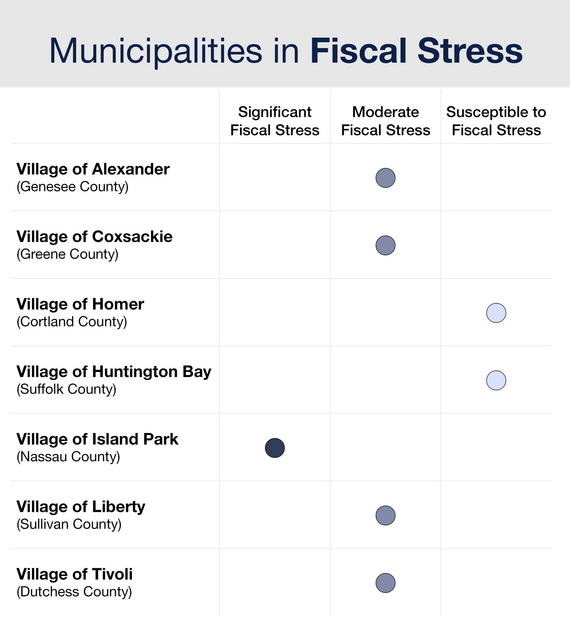
On March 21, 2026, New York State Comptroller Thomas P. DiNapoli announced that seven villages were designated in fiscal stress under his office’s Fiscal Stress Monitoring System (FSMS) for their fiscal year ending in 2025. DiNapoli’s office evaluated all non-calendar fiscal year local governments that filed their annual financial reports (AFR) in time to be scored. One village was designated in “significant fiscal stress,” four in “moderate fiscal stress,” and two as “susceptible to fiscal stress.”
The Village of Island Park (Nassau County) was classified in “significant fiscal stress.” The four villages designated in “moderate fiscal stress” were: Alexander (Genesee County), Coxsackie (Greene), Liberty (Sullivan) and Tivoli (Dutchess). The two villages classified as “susceptible to fiscal stress” were: Homer (Cortland) and Huntington Bay (Suffolk).
“The number of local governments with a fiscal stress designation remains low, but many cannot be evaluated because they do not file their required annual financial reports in time to be scored,” DiNapoli said. “A gap in filing is in itself a risk and creates a missed opportunity to identify fiscal stress and take corrective action before more drastic steps are needed. With uncertainty coming out of Washington having the potential to affect state and local funding and the economy, officials must closely monitor their financial condition to be able to adjust to changes that may lie ahead. I encourage local governments to use our self-assessment tool to help them budget and avoid pitfalls.”
The latest round of fiscal scores are for local governments with fiscal years ending between Feb. 28 and July 31, 2025, including 518 villages, most of which have a fiscal year ending on May 31. The scores, which are based on self-reported data, also cover 17 cities with non-calendar fiscal years, including the “Big 4” cities of Buffalo, Rochester, Syracuse and Yonkers, each of which have fiscal years ending on June 30.

Local governments are statutorily required to file an AFR with DiNapoli’s office following the close of their fiscal year. In total, 101, or almost 20% of local governments did not file their AFR in time to receive a FSMS score, a date that is at least three months past their statutory filing deadline. Over 386,000 New Yorkers reside in these municipalities.
Notably, three villages did not file in time to receive a score for 2025 and were in stress in fiscal year 2024: Saugerties (Ulster), Washingtonville (Orange) and Kaser (Rockland). The number of non-filers with non-calendar fiscal years has doubled since 2014.
DiNapoli’s office continues an outreach campaign to remind local officials of the statutory filing deadlines and provide assistance as needed and recently launched an online resource that highlights the importance of the AFR and tracks non-filers. It includes a tool for the public to check the filing status of any local government.
FSMS, which DiNapoli launched in 2012, assesses levels of fiscal stress in local governments using financial indicators including year-end fund balance, cash position, short-term cash-flow borrowing and patterns of operating deficits. It generates overall fiscal stress scores, which ultimately determine designations. The system also separately analyzes environmental indicators to provide insight about local economies and other challenges that may affect a local government’s or school district’s finances. This information includes population trends, poverty and unemployment.
DiNapoli’s office provides a self-assessment tool that allows local officials to calculate fiscal stress scores based on current and future financial assumptions. Officials can use this tool to assist in budget planning, which is especially helpful during periods of revenue and expenditure fluctuations.
In January, DiNapoli released fiscal stress scores for school districts. In September, his office will release scores for municipalities with a calendar-year fiscal year, which includes counties, towns, most cities and a few villages.
List of Villages and Cities in Fiscal Stress
Municipalities in Fiscal Stress
List of Villages and Cities that Failed to File Financial Information
Municipalities that Failed to File or Inconclusive List
Complete List of Fiscal Stress Scores
Data Files
FSMS Search Tool
Tool
AFR Non-Filers
Webpage Tracker Tool
Mar 21, 2026
Selected items from blogs posted on the Internet during the week ending March 20, 2026
CALL FOR ENTRIES for the AI 50 Awards 2026! The Center for Public Sector AI invites all US state, local, and tribal governments, education and nonprofit entities, as well as private industry partners, that are advancing artificial intelligence, to participate in the AI 50 Awards 2026. Submissions are due April 10. LEARN MORE
4 Ways Government Organizations Are Driving Efficiency Government and education organizations are under growing pressure to do more with fewer resources. This thought leadership white paper explores four proven ways SLED organizations are driving efficiency through modernization, from process mapping and AI-powered automation to cloud adoption and improved constituent experiences. DOWNLOAD