ARTIFICIAL INTELLIGENCE [AI] IS NOT USED IN COMPOSING NYPPL SUMMARIES OF JUDICIAL AND QUASI-JUDICIAL DECISIONS.

Apr 22, 2025

A New York City Office of Administrative Trials and Hearings Administrative Law Judge recommended dismissal of disciplinary charges filed against a New York City Probation Officer

OATH Administrative Law Judge Kevin F. Casey found a probation officer guilty of insubordination and conduct prejudicial to good order and discipline as the result of her wearing business attire to work "instead of a polo shirt required by a new dress code" and other clothing required by the Employer's new dress code

The probation officer, whose duties included regular courtroom appearances, was charged with misconduct for not wearing a Department-issued polo shirt with the agency’s logo. In addition, the new dress code required the probation officers required to provide, at their own expense, "blue cargo pants, black shoes, and lightweight jackets with the Department’s logo" that was to be worn. 

Citing Ferreri v. NYS Thruway Authority, 62 N.Y.2d 855, the ALJ's observed that employees "were required to obey a supervisor’s order; if the employee believes that an order is improper, the employee can later grieve it through appropriate channels". Judge Casey also noted that the Probation Officer "failed to show that the order to wear the shirt was unlawful, clearly beyond management’s authority, or imminently threatening to health or safety."

However, Judge Casey also found that the Department improperly retaliated against the officer for complaining about the new "dress code" to the Commissioner’s representative and the Department’s General Counsel. 

The ALJ said that the record, the Probation Officer’s credible testimony and other evidence indicated that less than one week after complaining about the new policy, the Department took adverse employment action against the officer by transferring her to another unit, in a different borough, without following Department procedures for involuntary transfers and imposing an unlawful 30 work-day pre-trial suspension without pay.

The ALJ recommended the that the Appointing Authority dismiss all of the disciplinary charges filed against the Probation Officer.

Click HERE to access Judge Casey's findings and recommendation posted on the Internet.


Apr 21, 2025

Fiscal Stress reports for some New York State cities and villages issued by New York State's Comptroller Thomas P. DiNapoli

On April 17, 2025, New York State Comptroller Thomas P. DiNapoli announced that nine villages were designated as being in fiscal stress under his office’s Fiscal Stress Monitoring System (FSMS) for their fiscal year ending in 2024. 

DiNapoli’s office evaluated all non-calendar year local governments that filed their financial reports in time to be scored and designated three villages in “significant fiscal stress,” two in “moderate fiscal stress,” and four as “susceptible to fiscal stress.”

The Village of Island Park (Nassau County), the Village of Saugerties (Ulster County) and the Village of Cambridge (Washington County) were classified in “significant fiscal stress.” 

The two villages designated in “moderate fiscal stress” were: Coxsackie (Greene County) and Washingtonville (Orange County). 

The four villages classified as “susceptible to fiscal stress” were: Huntington Bay (Suffolk County), Kaser (Rockland County), Chateaugay (Franklin County) and Liberty (Sullivan County).

“The number of local governments with a fiscal stress designation remains low following several years of emergency federal pandemic aid that helped stabilize their finances.” DiNapoli said: “With that aid coming to an end and uncertainty coming out of Washington on state and local funding cuts, local officials should closely monitor their financial condition so they can be prepared for any financial challenges that lie ahead. I encourage local governments to use our self-assessment tool to help them budget and avoid potential pitfalls.”

The latest round of fiscal scores reported for local governments cover those ending between Feb. 28, 2024, and July 31, 202, and included 518 villages, most of which have a fiscal year ending on May 31. 

The scores, which are based on self-reported data, also cover 17 cities with non-calendar fiscal years, including the “Big 4”: the cities of Buffalo, Rochester, Syracuse and Yonkers, each of which have fiscal years ending on June 30, 2024.

Local governments are statutorily required to file an Annual Financial Report (AFR) with the Office of the State Comptroller following the close of their fiscal year. In total, 108 local governments did not file their data in time to receive a FSMS score, a date that is at least three months past their statutory filing deadline. This represents approximately 20% of the local governments evaluated in this period. Over 482,000 New Yorkers reside in these municipalities.

The Comptroller's office continues to remind local officials of both the statutory filing deadlines, as well as the critical filing dates for receiving a fiscal stress score. His office recently launched a webpage that highlights the importance of the AFR and the concerning increase in the number of non-filers. The webpage includes a tool to check the filing status of any local government.

FSMS, which DiNapoli launched in 2012, assesses levels of fiscal stress in local governments using financial indicators including year-end fund balance, cash position, short-term cash-flow borrowing, and patterns of operating deficits. It generates overall fiscal stress scores, which ultimately determine designations. The system also analyzes separate environmental indicators to help provide insight into the health of local economies and other challenges that might affect a local government’s or school district’s finances. This information includes population trends, poverty, and unemployment.

DiNapoli’s office has a self-assessment tool that allows local officials to calculate fiscal stress scores based on current and future financial assumptions. Officials can use this tool to assist in budget planning, which is especially helpful during periods of revenue and expenditure fluctuations.

In January, 2024, DiNapoli released fiscal stress scores for school districts. In September, his office will release scores for municipalities with a calendar-year fiscal year, which includes counties, towns, most cities and a few villages.

List of Villages and Cities in Fiscal Stress
Municipalities in Fiscal Stress

List of Villages and Cities that Failed to File Financial Information
Municipalities that Failed to File or Inconclusive List

Complete List of Fiscal Stress Scores
Data Files

FSMS Search Tool
Tool

AFR Non-Filers
Webpage
Tracker Tool


Apr 20, 2025


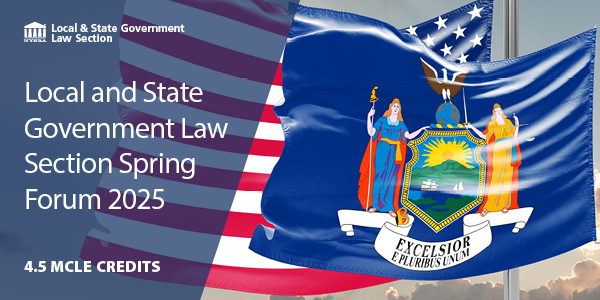
Spring Forum 2025_gen_600

1.0 Areas of Professional Practice; 1.0 Diversity, Inclusion & Elimination of Bias; 2.5 Ethics and Professionalism

Friday, May 2, 2025
12:30 p.m. – 5:00 p.m.

Free to All

Three Registration Options Available

In-Person and Zoom Available

In-Person and Zoom Available

In-Person and Zoom Available

Join the Local and State Government Law Section and the Committee on Diversity, Equity, and Inclusion on May 2 for our annual Spring Forum. This year’s forum examines key legal issues shaping equity, governance, and technology. Topics include:

  • Government-Sponsored Segregation in Housing & Finance – The legal history and ongoing impact of discriminatory policies.
  • Tribal Sovereignty & Cultural Restitution – Legal frameworks supporting Indigenous rights and repatriation.
  • Government Ethics & Morality – Navigating ethical dilemmas in public service.
  • AI & Legal Practice – Addressing bias and ensuring fairness in legal tech.

Gain insights from experts on past injustices and emerging legal challenges to promote a more just future.

This program offers valuable insights for legal professionals seeking to understand the historical and ethical foundations of current legal challenges while exploring innovative approaches for a more just future. 

                                                       Posted by NYPPL Pro Bono

Sponsors

Local and State Government Law Section
Committee on Diversity, Equity, and Inclusion
Committee on Continuing Legal Education

Editor in Chief Harvey Randall served as Director of Personnel, State University of New York Central Administration; Director of Research, Governor's Office of Employee Relations; Principal Attorney, Counsel's Office, New York State Department of Civil Service; and Colonel, JAG, Command Headquarters, New York Guard. Consistent with the Declaration of Principles jointly adopted by a Committee of the American Bar Association and a Committee of Publishers and Associations, the material posted to this blog is presented with the understanding that neither the publisher nor NYPPL and, or, its staff and contributors are providing legal advice to the reader and in the event legal or other expert assistance is needed, the reader is urged to seek such advice from a knowledgeable professional.

CAUTION

Subsequent court and administrative rulings, or changes to laws, rules and regulations may have modified or clarified or vacated or reversed the information and, or, decisions summarized in NYPPL. For example, New York State Department of Civil Service's Advisory Memorandum 24-08 reflects changes required as the result of certain amendments to §72 of the New York State Civil Service Law to take effect January 1, 2025 [See Chapter 306 of the Laws of 2024]. Advisory Memorandum 24-08 in PDF format is posted on the Internet at https://www.cs.ny.gov/ssd/pdf/AM24-08Combined.pdf. Accordingly, the information and case summaries should be Shepardized® or otherwise checked to make certain that the most recent information is being considered by the reader.
THE MATERIAL ON THIS WEBSITE IS FOR INFORMATION ONLY. AGAIN, CHANGES IN LAWS, RULES, REGULATIONS AND NEW COURT AND ADMINISTRATIVE DECISIONS MAY AFFECT THE ACCURACY OF THE INFORMATION PROVIDED IN THIS LAWBLOG. THE MATERIAL PRESENTED IS NOT LEGAL ADVICE AND THE USE OF ANY MATERIAL POSTED ON THIS WEBSITE, OR CORRESPONDENCE CONCERNING SUCH MATERIAL, DOES NOT CREATE AN ATTORNEY-CLIENT RELATIONSHIP.
New York Public Personnel Law. Email: publications@nycap.rr.com