ARTIFICIAL INTELLIGENCE [AI] IS NOT USED IN COMPOSING NYPPL SUMMARIES OF JUDICIAL AND QUASI-JUDICIAL DECISIONS.

Mar 24, 2026

Evaluating a discrimination or hostile work environment claim

Supreme Court, granted the Employer's motions to dismiss certain causes of advanced in  Petitioner's employment discrimination complaint. The Appellate Division unanimously reversed the Supreme Court's ruling, on the law, without costs, denied the Defendant's motions at issue and reinstated those causes of action.

The Appellate Division noted the Supreme Court had correctly observed that employment discrimination cases are generally reviewed under notice pleading standards and that a "plaintiff alleging employment discrimination need not plead specific facts establishing a prima facie case of discrimination but need only give fair notice of the nature of the claim and its grounds". 

Citing Petit v Department of Educ. of City of N.Y., 177 AD3d 402, the Appellate Division explained that "In an action brought under the New York City Human Rights Law (NYCHRL) and the New York State Human Rights Law (NYSHRL), "[f]air notice is all that is required to survive at the pleading stage" and noted that NYSHRL was amended in 2019 to "put in place a more lenient standard of liability that has been likened to that of the NYCHRL".

In the words of the Appellate Division: "Although a 'single, isolated comment' or 'stray remark' will not always suffice to sustain a discrimination or hostile work environment claim ... 'a single comment that objectifies women being made in circumstances where that comment would, for example, signal views about the role of women in the workplace' could be actionable ... Here, where [Petitioner] alleged that her supervisor implied that she only received high evaluation scores because she was engaging in sexual relations with higher-ups, the alleged remarks and attendant hostile conduct were more than 'petty slights and trivial inconveniences'".

Click HERE to access the Appellate Division's decision posted on the Internet.


Mar 23, 2026

SUNY Research Webinar highlighting the women who shaped New York State’s past and continue to inspire its future

Join the SUNY Research Foundation Webinar on Wednesday, March 25, 2026 highlighting the women who shaped New York State’s past and continue to inspire its future. Hear from the Radley Fellows as they share their groundbreaking research.

This event honors the vision of Dr. Virginia Radley, whose fellowship uplifts SUNY scholars exploring women’s leadership, the humanities, and inclusive civic impact.

Register today at https://ow.ly/6y6C50YwwLW

New York State Comptroller Thomas P. DiNapoli releases 2025 fiscal scores for certain New York State Villages and some New York State Cities

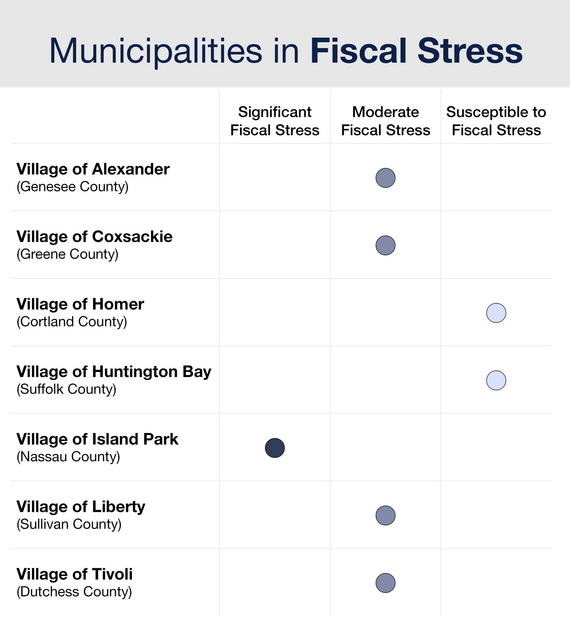
On March 21, 2026, New York State Comptroller Thomas P. DiNapoli announced that seven villages were designated in fiscal stress under his office’s Fiscal Stress Monitoring System (FSMS) for their fiscal year ending in 2025. DiNapoli’s office evaluated all non-calendar fiscal year local governments that filed their annual financial reports (AFR) in time to be scored. One village was designated in “significant fiscal stress,” four in “moderate fiscal stress,” and two as “susceptible to fiscal stress.”

The Village of Island Park (Nassau County) was classified in “significant fiscal stress.” The four villages designated in “moderate fiscal stress” were: Alexander (Genesee County), Coxsackie (Greene), Liberty (Sullivan) and Tivoli (Dutchess). The two villages classified as “susceptible to fiscal stress” were: Homer (Cortland) and Huntington Bay (Suffolk).

“The number of local governments with a fiscal stress designation remains low, but many cannot be evaluated because they do not file their required annual financial reports in time to be scored,” DiNapoli said. “A gap in filing is in itself a risk and creates a missed opportunity to identify fiscal stress and take corrective action before more drastic steps are needed. With uncertainty coming out of Washington having the potential to affect state and local funding and the economy, officials must closely monitor their financial condition to be able to adjust to changes that may lie ahead. I encourage local governments to use our self-assessment tool to help them budget and avoid pitfalls.”

The latest round of fiscal scores are for local governments with fiscal years ending between Feb. 28 and July 31, 2025, including 518 villages, most of which have a fiscal year ending on May 31. The scores, which are based on self-reported data, also cover 17 cities with non-calendar fiscal years, including the “Big 4” cities of Buffalo, Rochester, Syracuse and Yonkers, each of which have fiscal years ending on June 30.
FSMS

Local governments are statutorily required to file an AFR with DiNapoli’s office following the close of their fiscal year. In total, 101, or almost 20% of local governments did not file their AFR in time to receive a FSMS score, a date that is at least three months past their statutory filing deadline. Over 386,000 New Yorkers reside in these municipalities.

Notably, three villages did not file in time to receive a score for 2025 and were in stress in fiscal year 2024: Saugerties (Ulster), Washingtonville (Orange) and Kaser (Rockland). The number of non-filers with non-calendar fiscal years has doubled since 2014.

DiNapoli’s office continues an outreach campaign to remind local officials of the statutory filing deadlines and provide assistance as needed and recently launched an online resource that highlights the importance of the AFR and tracks non-filers. It includes a tool for the public to check the filing status of any local government.

FSMS, which DiNapoli launched in 2012, assesses levels of fiscal stress in local governments using financial indicators including year-end fund balance, cash position, short-term cash-flow borrowing and patterns of operating deficits. It generates overall fiscal stress scores, which ultimately determine designations. The system also separately analyzes environmental indicators to provide insight about local economies and other challenges that may affect a local government’s or school district’s finances. This information includes population trends, poverty and unemployment.

DiNapoli’s office provides a self-assessment tool that allows local officials to calculate fiscal stress scores based on current and future financial assumptions. Officials can use this tool to assist in budget planning, which is especially helpful during periods of revenue and expenditure fluctuations.

In January, DiNapoli released fiscal stress scores for school districts. In September, his office will release scores for municipalities with a calendar-year fiscal year, which includes counties, towns, most cities and a few villages.

List of Villages and Cities in Fiscal Stress
Municipalities in Fiscal Stress

List of Villages and Cities that Failed to File Financial Information
Municipalities that Failed to File or Inconclusive List

Complete List of Fiscal Stress Scores
Data Files

FSMS Search Tool
Tool

AFR Non-Filers
Webpage Tracker Tool


Editor in Chief Harvey Randall served as Director of Personnel, State University of New York Central Administration; Director of Research, Governor's Office of Employee Relations; Principal Attorney, Counsel's Office, New York State Department of Civil Service; and Colonel, JAG, Command Headquarters, New York Guard. Consistent with the Declaration of Principles jointly adopted by a Committee of the American Bar Association and a Committee of Publishers and Associations, the material posted to this blog is presented with the understanding that neither the publisher nor NYPPL and, or, its staff and contributors are providing legal advice to the reader and in the event legal or other expert assistance is needed, the reader is urged to seek such advice from a knowledgeable professional.

CAUTION

Subsequent court and administrative rulings, or changes to laws, rules and regulations may have modified or clarified or vacated or reversed the information and, or, decisions summarized in NYPPL. For example, New York State Department of Civil Service's Advisory Memorandum 24-08 reflects changes required as the result of certain amendments to §72 of the New York State Civil Service Law to take effect January 1, 2025 [See Chapter 306 of the Laws of 2024]. Advisory Memorandum 24-08 in PDF format is posted on the Internet at https://www.cs.ny.gov/ssd/pdf/AM24-08Combined.pdf. Accordingly, the information and case summaries should be Shepardized® or otherwise checked to make certain that the most recent information is being considered by the reader.
THE MATERIAL ON THIS WEBSITE IS FOR INFORMATION ONLY. AGAIN, CHANGES IN LAWS, RULES, REGULATIONS AND NEW COURT AND ADMINISTRATIVE DECISIONS MAY AFFECT THE ACCURACY OF THE INFORMATION PROVIDED IN THIS LAWBLOG. THE MATERIAL PRESENTED IS NOT LEGAL ADVICE AND THE USE OF ANY MATERIAL POSTED ON THIS WEBSITE, OR CORRESPONDENCE CONCERNING SUCH MATERIAL, DOES NOT CREATE AN ATTORNEY-CLIENT RELATIONSHIP.
New York Public Personnel Law. Email: publications@nycap.rr.com